
By Diana Spahia, Senior Research Associate
With free 2K piloting in New York City and Governor Hochul pledging to expand child care across New York, policymakers and families alike are looking for ways to make it real—and sustainable. Based on what's worked in other states, paid family leave (PFL) has emerged as a potential part of the equation.
Child care and PFL are traditionally discussed and funded separately, but, for families with newborns, they are closely related. Paid leave affects when parents return to work and, consequently, how long they can afford to delay childcare enrollment. For families, having affordable child care options accompanied by a robust PFL insurance program would allow for a truer degree of independence when making the hard choice about staying at home or returning to work. Yet as universal child care is becoming a major policy lever for affordability in New York, paid family leave has not been updated in years. And for the New York State, policy changes to the current PFL program could allow for more flexibility and cost savings.
CUNY ISLG recently released a return-on-investment analysis on universal child care in New York, which outlined the economic and social impacts the policy would have. To add to this discussion, we’re outlining what PFL is now and what changing the policies could mean for workers, families, and New York at large.
What is paid family leave?
New York’s paid family leave program provides eligible workers with up to 12 weeks of partially paid time off to care for family members. This includes newborn bonding, where both parents may take leave within the child’s first year. As of 2026, PFL replaces 67 percent of a worker’s average weekly wage, up to $1,228.53 per week. Unlike New York’s schools and public child care options, which are funded by city, state, and federal taxes, PFL is an insurance program funded by employees through a payroll deduction capped at $411.91 for the year.
Where does paid family leave fall short?
PFL is an important support for working families, but several aspects of the program warrant closer attention. The 67 percent wage-replacement rate has not increased since 2021, when it was fully phased in. Although the maximum weekly benefit changes each year with the statewide average weekly wage, workers still give up roughly one-third of their regular earnings while on leave. Workers whose average weekly wage exceeds $1,833.63 face an even larger proportional reduction because the weekly benefit is capped at $1,228.53 in 2026.
Eligibility also remains closely tied to tenure with a specific employer: generally, an employee must work 26 consecutive weeks if regularly scheduled for 20 or more hours per week, or 175 days if working fewer than 20 hours. These requirements can disproportionately affect workers in unstable, seasonal, or high-turnover jobs, who may experience childbirth, a family health emergency, or another qualifying event before they have been with their current employer long enough to use the benefit when they need it.
Requirements can disproportionately affect workers in unstable, seasonal, or high-turnover jobs, who may experience childbirth, a family health emergency, or another qualifying event before they have been with their current employer long enough to use the benefit when they need it.
Public employees are not automatically covered by New York’s PFL insurance program. A public employer may voluntarily opt into the program, and represented employees may obtain coverage through collective bargaining. In practice, some government workers receive parental leave through separate employer-specific policies rather than through PFL. For example, more than 170,000 eligible executive-branch state employees can receive up to 12 weeks of fully paid parental leave following a birth, adoption, or foster placement. Coverage across the public sector therefore remains a patchwork: some employees receive relatively generous benefits, while others depend on whether their employer has opted into PFL, negotiated coverage, or established a separate leave program. Independent contractors and freelancers must voluntarily purchase their own disability and PFL coverage, potentially with a substantial waiting period. Certain workers are excluded from the statutory definition of covered employment, including some clergy and religious workers and minor children employed by a parent; spouses working for a family business may also be excluded if the employer files the required exclusion.
In New York, contributions are capped at the statewide average wage, resulting in higher-income workers contributing a relatively smaller share of their total earnings towards PFL. In 2026, employees contribute 0.432 percent of their wages up to approximately $95,349 for a maximum annual contribution of $411.91. Because both the contribution and benefit are capped based on the statewide average weekly wage, a worker earning approximately $95,349 pays the same maximum contribution and is eligible for the same maximum benefit as someone earning substantially more. However, other states allow for the contribution cap to be higher than the maximum benefit, allowing higher earners to contribute more toward the insurance program without increasing their maximum benefit.
These limitations suggest that strengthening PFL requires more than increasing the number of weeks of leave available.
Taken together, these limitations suggest that strengthening PFL requires more than increasing the number of weeks of leave available. To truly make paid leave accessible to those who need it, especially lower wage workers, New York should examine whether the current wage replacement, tenure, and coverage rules allow the workers most likely to face economic insecurity to meaningfully access the program. Because as of now, as data discussed later shows, many families do not take full advantage.
Beyond New York: How Other States Tap into Paid Family Leave Programs
Twelve states and Washington, DC, currently pay statewide family leave benefits, and the terms vary. The states below illustrate specific policy choices that offer a different path than New York’s and could address current issues. New Jersey and Connecticut show that substantially higher wage replacement rates can be provided within an employee-funded model, while Colorado and Oregon combine progressive benefits with contributions from both employees and covered employers.
New York: 12 weeks; 67 percent of a worker’s average weekly wage, capped at 67 percent of the statewide average weekly wage; employees fund the program.
New Jersey: 12 weeks; up to 85 percent wage replacement; employees fund the program.
Connecticut: 12 weeks; up to 95 percent wage replacement; employees fund the program.
Colorado: 12 weeks; up to 90 percent wage replacement; employees and employers share the cost.
Oregon: 12 weeks; progressive benefits of up to 120 percent of the state average weekly wage; employees and employers share the cost.
New York’s 12-week leave duration is in line with many of the state programs now in operation, but its wage-replacement rate ranks near the bottom nationally. Among active mandatory state and District of Columbia programs in 2026, New York’s flat 67 percent rate is the second-lowest maximum replacement rate, exceeding only Rhode Island’s current 60 percent rate. Unlike New York’s flat percentage, Connecticut, Colorado, and Oregon use progressive formulas that replace a larger share of earnings for lower-paid workers.
In Connecticut, for example, the program replaces 95 percent of weekly earnings up to $677.60 and 60 percent of earnings above that threshold, subject to a maximum weekly benefit of $1,016.40. Oregon replaces 100 percent of wages for workers earning no more than 65 percent of the state average weekly wage; workers earning more receive a smaller percentage of their total wages, and benefits are capped at 120 percent of the state average weekly wage. New Jersey and Connecticut therefore demonstrate that an employee-funded program can provide higher wage replacement than New York, while Colorado and Oregon illustrate models in which employees and covered employers share program costs.
Paid Family Leave Can Mean Saving Time and Money for Families
To see whether expanding PFL could delay infant child care enrollment and reduce costs for both families and the state, we analyzed publicly available claims data and as well as developed a model to project cost.
NYDFS data shows that approximately 65,000 women residing in New York filed newborn bonding claims in 2023. Using this estimate, we modeled the value of child care that could be avoided if PFL were extended beyond 12 weeks, assuming an average cost of approximately $1,500 per month. If half of the approximately 65,000 claimants used one additional month of leave and delayed paid child care during that period, the avoided cost would be about $49 million. If all claimants did so, the avoided cost would be approximately $97 million. Extending leave from three to six months produces cumulative estimates of $195 million at 50 percent utilization and $292 million at 75 percent utilization.
Avoided costs would accrue to the State when it subsidizes care and to households when families pay for child care directly. This finding is illustrative of the fact that delayed enrollment may reduce the demand for infant care, which is among the most expensive and difficult types of care to secure.
New York’s Workers Are Not Using Their Full Leave
New York Department of Financial Services (NYDFS) data indicate that many workers do not use the full 12 weeks currently available: in 2023, the average newborn bonding claim was 9.1 weeks for women and 6.4 weeks for men. The data does not explain why workers used less leave, but they raise questions about whether additional weeks would be used at the current wage replacement rate, given that men only use slightly over half of their leave time, and women use ¾ of their leave time. At the current 67 percent replacement rate, a worker gives up approximately 1/3 of their regular wages while on leave. A worker earning $35,000 annually would normally earn about $2,692 over four weeks, but would receive approximately $1,804 through PFL—a reduction of nearly $900. For some families, that amount is often not enough to cover costs of living in New York and the additional costs that come with a new child. The data potentially supports that adding more weeks of leave without addressing wage replacement would likely limit who can take advantage of expanded leave.
If New York is considering an expansion to equalize the playing field for families with lower income levels, data points to the fact that wage replacement should be increased alongside length of leave.
The income distribution of claimants lends support to this concern: in 2023, approximately 14 percent of newborn bonding claimants earned less than $35,000, while 34 percent earned more than $88,000. While we cannot ascertain that wage replacement is the sole reason for the difference, it aligns with research findings that lower wage workers have less access to paid leave and are less able to take full leave time with such reduced earnings. If New York is considering an expansion to equalize the playing field for families with lower income levels, data points to the fact that wage replacement should be increased alongside length of leave. Taken together, these estimates suggest that PFL and infant care investments can and should be planned as complementary parts of the same continuum: paid leave can support families and defer public and household child care costs during a child’s earliest months, while infant care investments can be targeted to the point when parents are ready to return to work.
How To Expand Benefits
Other states with PFL coverage provide examples of higher wage replacement rates and different financing structures. Ways to increase wage replacement and/or leave time in New York include:
Increasing the employee deduction for all covered workers.
Connecticut’s program is entirely employee-funded through a 0.5% payroll deduction, compared with New York’s 0.432% deduction in 2026.
Raising the contribution wage cap so that higher-paid workers contribute on a larger share of their earnings.
Connecticut applies its 0.5 percent employee deduction to wages up to the federal Social Security taxable wage limit—$184,500 in 2026—compared with New York’s effective contribution wage cap of approximately $95,349. Connecticut’s weekly benefit remains capped at $1,016.40.
New Jersey applies its 0.23 percent employee Family Leave Insurance contribution to the first $171,100 in wages in 2026, producing a maximum annual contribution of $393.53. Benefits replace 85 percent of a worker’s average weekly wage but are capped at $1,119 per week.
Oregon also applies contributions to wages up to the 2026 federal Social Security taxable wage limit of $184,500.
Requiring an employer contribution.
Colorado divides program costs equally between employees and employers with at least 10 workers.
In Oregon, employees pay 60% of the total contribution and employers with at least 25 workers pay 40%.
Combined approaches.
Oregon applies a 1% total contribution to wages up to $184,500, with employees paying 0.6% and employers with at least 25 workers paying 0.4%. This broader financing structure supports 100% wage replacement for workers earning approximately $47,700 or less annually.
Any changes in PFL contributions and benefits would require actuarial analysis because higher benefits would likely increase utilization and associated costs. The example below is not an actuarial assessment, but it can highlight tradeoffs when considering alternative scenarios. For example, per the table below, if a worker earning $35,000 receives 85 percent wage replacement and a 0.5 percent payroll deduction, that would increase the annual contribution from $151 to $175. The worker would pay about $24 more per year, but receive $2,288 rather than $1,804 for four weeks of leave.
Temporary Disability Insurance is a Key Area for Reform
New York’s Temporary Disability Insurance (TDI) program provides another option for supporting families immediately following a birth. Birthing parents may use TDI for six to eight weeks before or after taking PFL, but the maximum benefit has remained $170 per week for 37 years—since 1989. This is less than 10 percent of the state’s current average weekly wage. Updating TDI would improve income protection for birthing parents, although it would not replace the need to reevaluate the broader PFL program available to both parents and non-birthing families.
Paid Family Leave is Part of the Broader Child Care Strategy
Paid leave is a crucial part of the childcare puzzle: families should be able to afford to take maximum leave to bond with their child, and they also need affordable and high-quality care when they return to work. A balanced approach would benefit everyone: a stronger PFL insurance program allows families to delay infant care, reduce household expenses, and alleviate demand for infant care. Research summarized in CUNY ISLG’s analysis also associates paid leave with improved maternal mental health, fewer infant hospital admissions, greater household economic security, and stronger maternal labor force participation. Although these studies examine different programs and outcomes, they suggest that the effects may extend beyond the leave period.
As the Hochul administrations consider how to expand child care, it should also examine whether the current PFL structure allows families across lower income brackets to use all of the leave time available to them. The data suggests that additional weeks could have value, but wage replacement should be of critical concern. Pairing childcare investments with a more usable paid leave benefit would provide families with support both before and after they need care outside of the home.
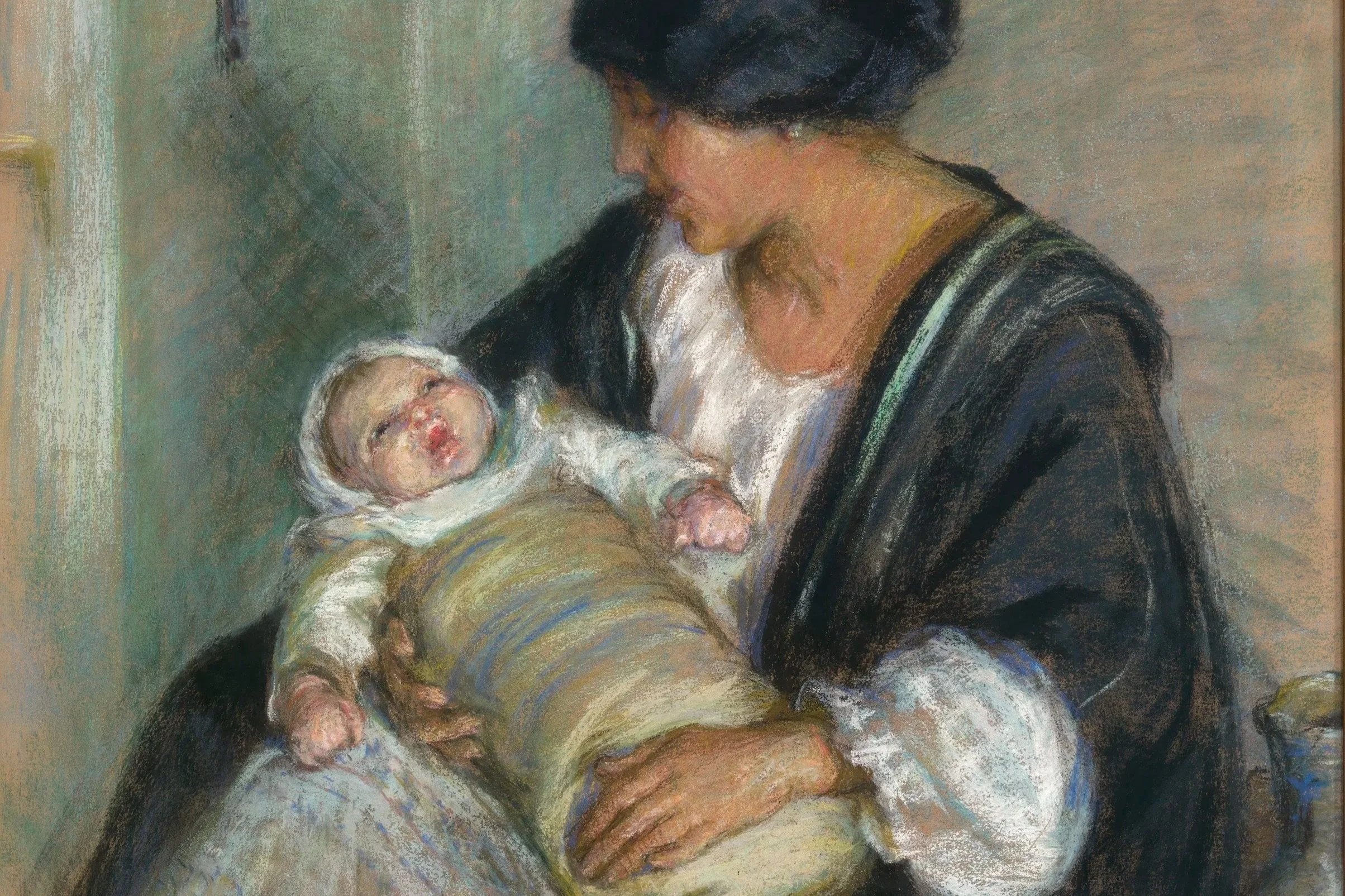
Painting: “Mother and Crying Baby” (detail) by Alice Pike Barney, 1911. Smithsonian American Art Museum.