
This guide, created for policymakers, legislative staff, researchers, advocates, and the public, helps to clarify the New York State budget process and to shed light on who makes key decisions, how and when decisions take shape, and where there are opportunities to provide input.
This work complements New York State's official Citizen's Guide to the budget by focusing on how the budget process operates in practice. Together, the two publications provide both the formal framework and the practical context needed to understand New York State's budget process.
For details on the New York City budget process, see our City-specific report. The final report in our three-part series will cover how City and State processes work in tandem.
The Timeline, Actors, and Access Points of the New York State Budget Process
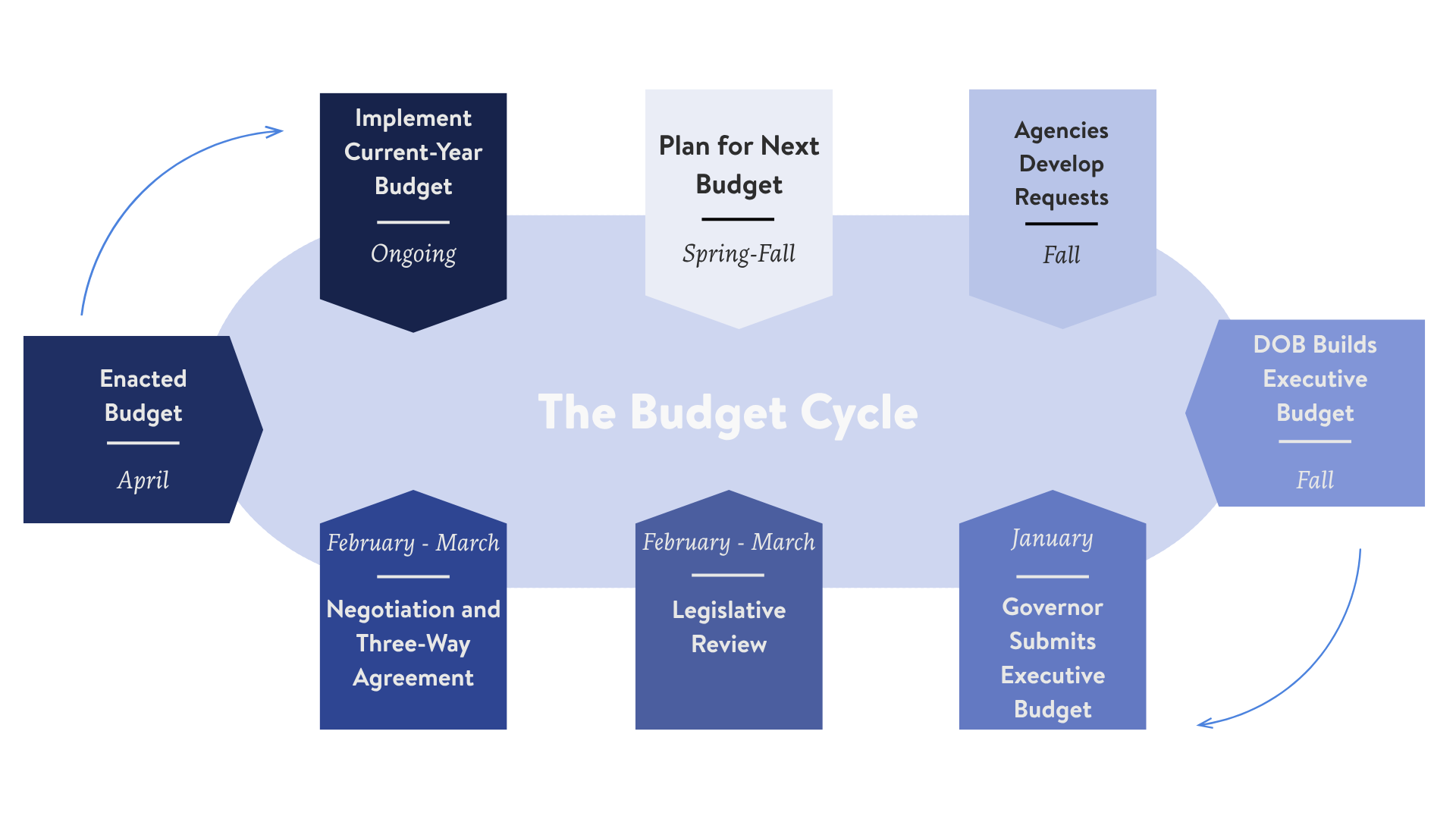
The New York State budget is the product of a year-round process involving the governor, legislature, Division of the Budget (DOB), state agencies, local governments, public authorities, advocacy organizations, and the public. Each contributes at different stages and in different capacities to the development, review, negotiation, adoption, implementation, and oversight of the State budget.

ABOUT THE DATA
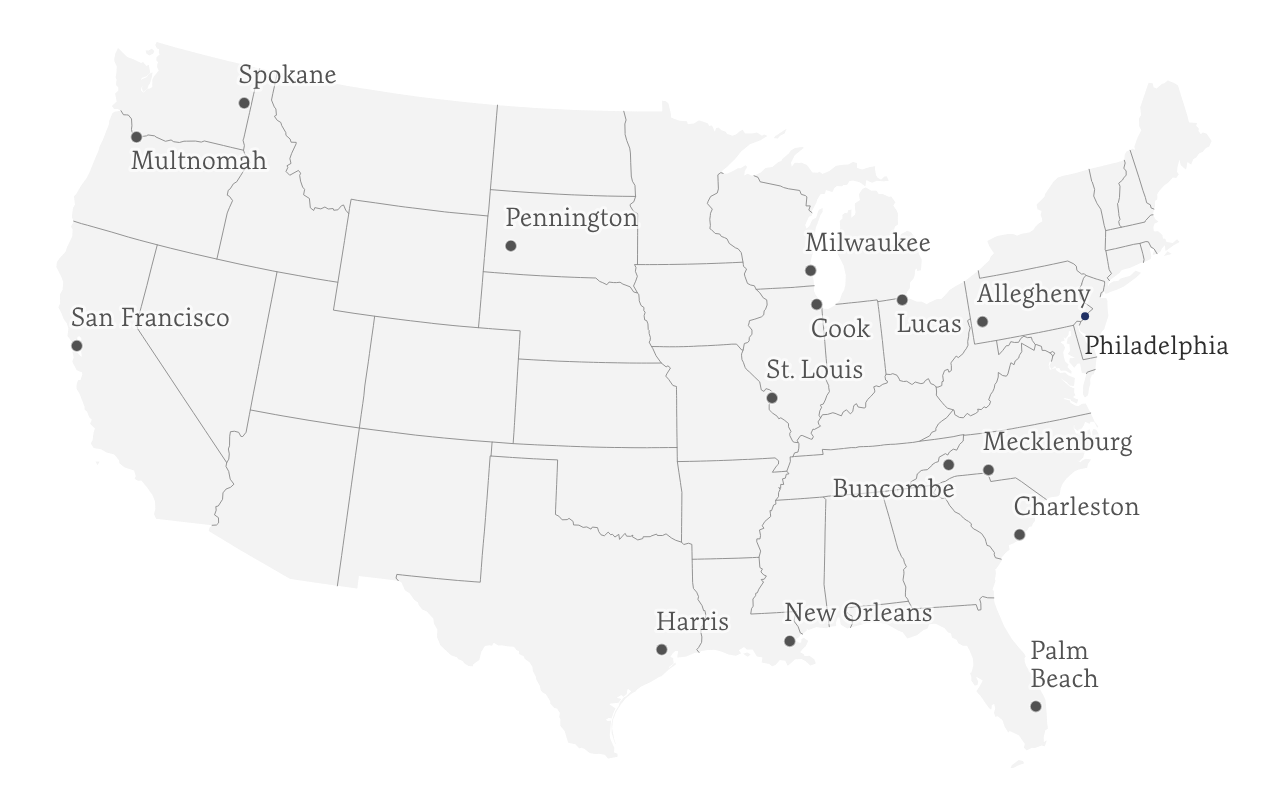
WHO: 17 Safety and Justice Challenge jurisdictions. Average Daily Population (ADP) and Incarceration Rate do not include Philadelphia County.
WHAT: Administrative case-level jail data
WHEN: January 2018 to December 2024; Quarterly jail data available through April 2025
HOW: Exploratory and descriptive analysis of jail metrics and trends
KEY FINDING 1: After declining before and during the pandemic, the population of women in jail has risen since 2021. This has reversed much of the progress made in prior years, both nationally and, more substantially, in SJC sites.
KEY FINDING 2: When compared to men, rates of women held in SJC site jails have fared worse post-pandemic, with larger proportional increases in incarceration rates, booking rates, and average length of stay (ALOS) at release.
KEY FINDING 2.1: The most recent available data by quarter (February to April 2025) shows the disproportionate impact for women in jail has continued to increase, with average daily population (ADP) rising 54 percent from the February-April 2021 period compared to only 11 percent for men.
KEY FINDING 3: Women of color continue to be disproportionately booked and incarcerated at higher rates than white women, highlighting the importance of intersectionality when studying patterns in jail trends.
To better understand the drivers behind these shifts, CUNY ISLG conducted an analysis of booking patterns and charge-level data across SJC sites. By examining 1.9 million new charge bookings from 2018 to 2024, researchers compared trends over time and between men and women. This included a focus on whether shifts in the types of charges women were being booked on were contributing to these patterns.
ABOUT THE DATA
WHO: 16 Safety and Justice Challenge jurisdictions (excluding Philadelphia County from the first analysis)
WHAT: 1.9 million new charge bookings; 406,321 (21 percent) women
WHEN: January 2018 to December 2024
HOW: More advanced statistical analyses (i.e., t-tests for differences) to compare groups (such as men vs. women and number women’s bookings for charge types from 2018-2019 to 2024) and determine whether the differences observed were statistically significant (actual differences and not due to chance alone at p<0.001).
KEY FINDING 4: Women are more likely to be booked on a new misdemeanor charge than men, including property and drug-related offenses.
Even though many sites in the SJC have worked to cut down on jail bookings for low-level offenses, women are still being booked at higher rates than men for new misdemeanor charges. This includes common misdemeanor offense categories like minor property charges (e.g., shoplifting) and drug-related charges. While overall progress has been made to reduce unnecessary jail use, particularly for lower-level misdemeanor charges, that progress is not translating equally for women and men.
KEY FINDING 5: Despite a reduction in overall new charge bookings between 2018-2019 and 2024, new charge bookings for UCR-person, expanded violent, and domestic violence charges have increased for women.
-
UCR-person offenses are index offenses measured by the FBI Uniform Crime Reports (e.g., homicide, aggravated assault, robbery, rape/sexual assault) while the expanded violent category incorporates both UCR-person and other violent offenses (e.g., simple assault/battery, endangerment, threat offenses, etc.)]
Additionally, research on jurisdictions with mandatory arrest policies (MAP) (i.e., when law enforcement respond to a call involving domestic violence, they must make an arrest) show that law enforcement in areas with MAP often arrest both people—the victim and the perpetrator—when responding to a domestic violence call for service. As a result, charges that appear in administrative data as new violent or domestic violence–related bookings may reflect a more complex set of circumstances, including retaliatory violence, resistance violence, self-defense, false accusations by abusers, or mandatory arrest policies themselves.
The findings in this brief point to a more complicated picture of progress than overall jail population trends might suggest. While many jurisdictions made real gains in reducing jail use before and during the pandemic, those gains have not held equally for women; in the post-pandemic period, the gap has even widened.
The pandemic and its aftermath may have disrupted reform efforts or introduced new pressures—economic hardship, housing instability, strained social services—that are contributing to increased system involvement for women. This underscores the need to revisit and strengthen any of the approaches that were working locally in SJC sites to visibly reduce jail populations before 2020, and to ask more directly why those approaches have proven less durable for women than for men following the pandemic.
LESSON 1: Universal reforms are proving less effective for women
While many jurisdictions have made important strides in reducing reliance on jail, these improvements have not been experienced equally across genders. This highlights the need to look beyond overall trends and examine who is most affected by current policies and practices, as well as how system responses may differ based on gender and circumstance.
Women—who often face different life circumstances, such as unequal caregiving responsibilities or increased economic instability—continue to be drawn into the system at disproportionate rates for less serious misdemeanor charges. This gap suggests that implemented reforms that were successful at reducing jail populations for both men and women prior to the pandemic, including those tied to reducing jail use for lower-level misdemeanor offenses, may no longer be working due to underlying factors compounding women’s involvement in these offenses following the pandemic, and that more targeted, gender-responsive approaches may be needed to create fairer outcomes. More targeted, gender-responsive approaches may be needed to create fairer outcomes.
LESSON 2: Data gaps mask an understanding of women’s experiences
Gaps in how data are collected and categorized, especially around domestic violence-related offenses, make it harder to fully understand and respond to these patterns. Domestic violence is not uniformly defined or tracked in the same way across jurisdictions and different states may apply broader or narrower definitions depending on statute, charging practices, or local data systems. Law enforcement discretion may also shape whether an incident is coded as domestic violence or charged as a general violent offense.
This issue is especially important because CUNY ISLG did not have the ability to systematically identify domestic violence offenses unless they were tied to a violation of a protective order in four of the 16 sites. In those sites, women booked on offenses connected to domestic violence may instead appear in a broader expanded violent offense or UCR person offense categories. Therefore, observed increases in women’s bookings for violent offenses should not be interpreted as a straightforward increase in women’s violence without considering how domestic violence incidents are defined, coded, and charged across jurisdictions. When these dynamics are not clearly identified in the data, it can lead to an incomplete picture and potentially miss the need for more nuanced, survivor-informed responses for women involved in the criminal legal system.
Additionally, women’s pathways into the system often differ from men’s, shaped by compounding longstanding gender-based economic, social, and medical disparities such as economic insecurity, caregiving roles, behavioral health needs, and exposure to trauma, including domestic violence. There is currently an SJC Research Consortium project underway focused specifically on the pathways to and experiences in jail for women in multiple sites that will be released later this year. Overall, these findings suggest that, alongside broader reform efforts, there is a need for better data tracking to inform more careful, context-specific approaches to ensure that women, especially those involved in complex domestic violence situations, are treated fairly and appropriately.
Together, these findings underscore key areas where disparities persist and where more tailored, gender-responsive, survivor-informed strategies may be necessary to achieve more effective reform.
project credits
Writing: Bryn Hill, Senior Research Associate
Editing: Carla Sinclair, Communications Project Director
Advisement: Stephanie Rosoff, Deputy Research Director; Jennifer Ferone, Deputy Research Director; Benjamin Estep, Research Project Director
Data Visualization: Samantha Parker, Research Associate
Web Development and Communication Design: Carla Sinclair, Communications Project Director
External Affairs: Kevin Dugan, Senior Communications Associate
Web Design Template: Design for Progress and Thought Driven Development
Acknowledgements
We’d like to extend special thanks to CUNY ISLG colleagues Jennifer Ferone, Deputy Research Director, and Benjamin Estep, Project Director, for their guidance on the creation of this report, and Samantha Parker, Research Associate, for her assistance in creating amazing data visualizations. We’re also grateful to the team who processes SJC data: Alexis Peachey, Research Associate; Brian Holliday, Data Scientist; Brandon Martinez, Research Associate; Douglas Evans, Senior Research Associate; Otgonjargal Okhidoi, Senior Research Associate; and Samantha Parker, Research Associate.
This work would be impossible without the support of the John D. and Catherine T. MacArthur Foundation and without the partnership of staff from SJC sites across the country. We greatly appreciative of your collaboration over the past 10 years.