“We're here to make it better for our residents and our children.” Q&A with NYS Assembly Chief of Staff Diana LaMattina Abdella
By Carla Sinclair, Communications Project Director
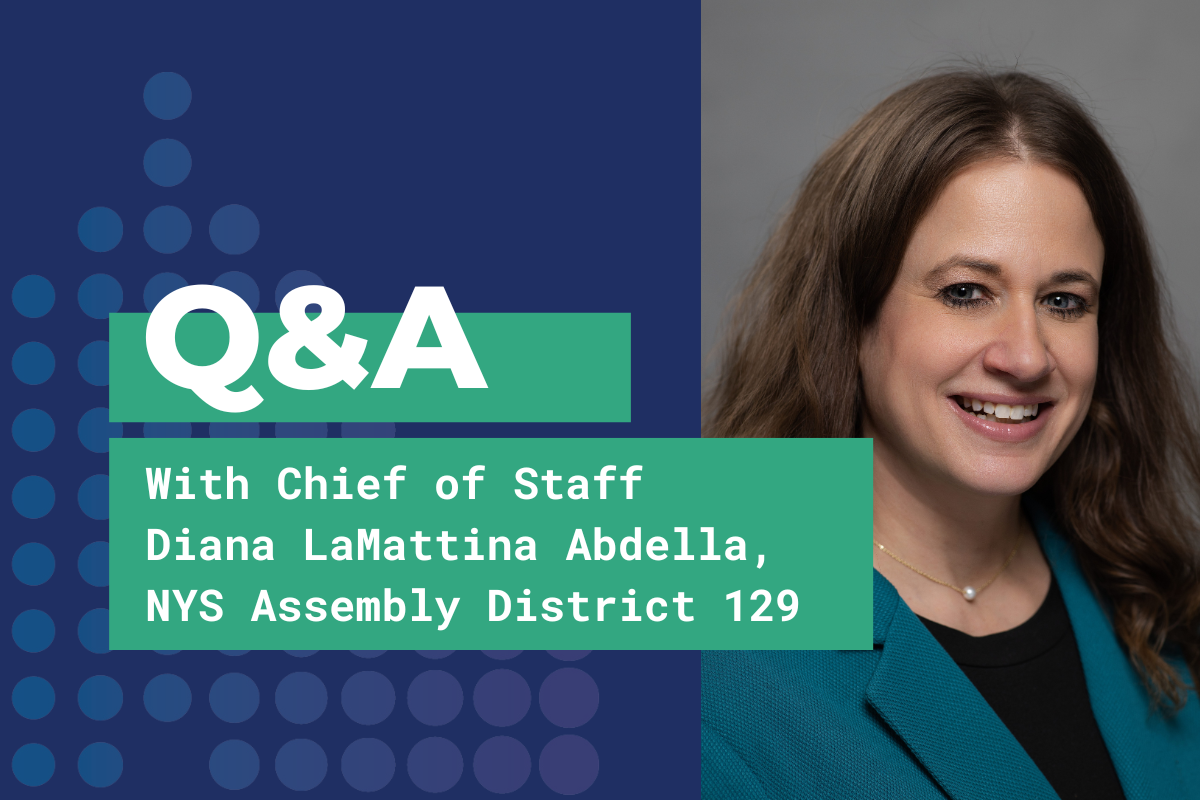
Chiefs of staff and other legislative office leaders are crucial to the districts they serve, but often operate behind the scenes. ISLG’s Kriegel Fellowship for Public Service Leaders taps into their unique roles to offer professional development and networking opportunities so they can exceed in their current jobs and their future journeys as policy experts. We sat down with one of the Fellows to discuss the role, what Kriegel has offered, the importance of state and local collaboration, and much more.
Whether they’re drafting legislation, tackling policy issues, or out listening to their communities, the chiefs of staff and other legislative office leaders play a vital role in New York City and State. With roles as diverse in responsibilities as the array of public policy issues they delve into, these staff need to be policy experts, legislative wonks, effective managers, and much more.
To support their success as a legislative champion as well as a community advocate, CUNY ISLG established the Kriegel Fellowship for Public Service Leaders in 2020 as a professional development and peer-to-peer learning opportunity for legislative chiefs of staff. The Fellowship has expanded to help all legislative office leaders gain insight into the pressures that influence policy decision-making, enhance their policy knowledge and leadership capacities, and collaborate with peers to more positively impact the future of New York City and State.
ISLG’s Senior Communications Associate, Carla Sinclair, sat down with Kriegel Fellow Diana LaMattina Abdella, who works as the Chief of Staff the New York State Assemblymember Bill Magnarelli, to talk about it all.
What is your name and role? What areas does your office represent?
My name is Diana LaMattina Abdella. I'm Chief of Staff for New York State Assemblyman Bill Magnarelli. Assemblyman Magnarelli represents the northwestern Syracuse area as well as parts of Geddes and Van Buren. He is also the head of the Assembly’s Transportation Committee.
Tell me more about what your job entails. What does it look like day-to-day, or week-to-week?
It's a bit of everything. I deal with communications, grants, scheduling, legislation, community outreach, and research. I also run the Central New York Veterans Parade and Expo, which is going into its 19th year. This is actually a good example of what it’s like working in a legislative office: about two weeks after I got hired, in 2008, he said, “Do you know anything about parades?” And I'm like, “You line people up, you push them down the street?” He had this idea of doing an old-time military parade for Veterans Day. And since then, we've put on an annual parade and expo honoring the military and veterans in the community. It's grown from just a parade into a day-long event that showcases 100 different organizations, companies, and groups that have connections to veterans. It’s that's quite an undertaking.
Overall, being a chief of staff is a lot of putting together things like that. It's a lot of dealing with the public but also doing the background paperwork and research that allows the legislator to do his job. It allows the legislator to be knowledgeable on the topics that he needs to go into session, or to go into a community meeting on a topic with the important facts. It’s getting recognition of the legislator and the office in the community, which can be a very difficult thing when you spend half the year in Albany in session, trying to debate bills and work for a budget.
How did you come to be in public service?
I went to college for English and Political Science. I knew in college I wanted to be a newspaper reporter, and I spent upwards of eight years being one. Most recently I was at the local daily, covering everything from health to schools to government to crime. It really gave me a sense of how important the community was to people, and what the resources are for people who live here.
But newspapers were starting to lose revenue, and that was about the time that I got out. I became communications representative for Assemblyman Magnarelli in 2008. From 2010 till about 2015, I worked part-time to raise my kids. It was great being able to work part-time while also being able to be around my kids. And in 2020, I became Chief of Staff. Two years ago, I also became elected to the school board in my community. I think it’s important to be involved that way, because when you're out in the community, you see what people are trying to do and what the community needs to function, what the residents need to thrive. You become invigorated, and you want to help them and make sure things are done properly.
“When you're out in the community, you see what people are trying to do and what the community needs to function, what the residents need to thrive.”
Why did you decide to be a Kriegel Fellow?
Being among other Fellows, you find yourself with people who have been in the complicated and unique situations that you’ve been in. Once you start that conversation of, “Have you encountered this? How do you handle it?,” it really opens your eyes to how you can make things much more efficient. Learning about the other levels of government represented in the Kriegel Fellowship also helps you understand what’s going on in other political spaces, because it doesn't happen in a vacuum.
Learning about what is going on and how others deal with it, you can recognize what needs to be strengthened and what you might need to pay more attention to. I've taken a couple of leadership programs, so I know how important it is to take the opportunities in front of you.
How has your experience in this Cohort been so far?
It's been great. It's interesting because it's all by Zoom for me, being so far north, but it's been a great opportunity to really have a more in-depth look at what all of the legislative offices are facing, to meet the other people in the offices. I've spoken to so many of them on the phone in the past or had to email them, and being able to even just see them on screen, or talk with them a bit, gives us a chance to make connections, and have more people as a resource.
The sessions have all been good, both as refreshers and as new troves of information. Some of the sessions, you go into it thinking, “That's not what I do,” or “That's not on my agenda.” But by the end I really see how it relates to the issues I'm dealing with. And some have been refresher courses, like the strategic communications session, which is nice. In these positions, you don't get constant training that some other professions do because you're constantly moving and working. You learn by doing. So having the opportunity to sit through a class and hear about what is most effective and how others are approaching certain issues and tasks gives you new ideas.
“In these positions, you don't get constant training that some other professions do because you're constantly moving and working. You learn by doing.
So having the opportunity to sit through a class and hear about what is most effective and how others are approaching certain issues and tasks gives you new ideas.”
For example, the state budget. We're heading into that season again, and the Kriegel session on it broke down the information and explained it in much more depth than I've ever really had time to have it explained before. It's taking what you know, and then really looking at it under a microscope, so that you learn particular details that you wouldn't usually have time or know how to get information on.
This was also true for the housing and immigration sessions. These topics are all relevant to many, if not all, communities around New York. Having others in the same position offer varying opinions and thoughts on how to approach things like affordable housing really sets the tone and gives you ideas to keep on the back burner in case it becomes relevant. Some cities and some areas are so much more impacted by these issues than we are, so we can learn from what they've encountered.
What does it mean to have this community of legislative staff members from other offices, both as Cohort colleagues and Fellowship alumni?
It makes the job less frustrating. It makes you realize that these issues we’re all dealing with are gigantic, and they’re not going to be solved in one meeting, in one memo. Having connections with people who are dealing with the same things, the same challenges, makes things clearer.
It’s also useful to network and meet people. Having someone you could shoot a question at, knowing they're dealing with the same situation.
What do you hope to take away from the Fellowship overall, and apply to wherever your path takes you?
It's a great opportunity to learn on a wider basis what state and city government does. It really allows you to look at the issues that you encounter all the time as a chief, to take a deeper look into what these issues mean on a broader scale, and how they're affecting lives around the state.
It’s been a great opportunity to dive into the bigger issues in public service, into how you go about doing your job, because there's so much. It's not one task. It's so broad. It's a nice balance a lot of the time, but being in the Fellowship helps you understand how to make sure that balance doesn't get off-balance. The Fellowship helps you look at what you have to do as a public servant to make things run smoothly, in a way that is more efficient and represents not only your area, but the entire state.
I grew up in this community and I'm very tied to it. I really want to keep working in the community and learn about the best ways to make things better. We're here to make it better for our residents and our children.
“I grew up in this community and I'm very tied to it. I really want to keep working in the community and learn about the best ways to make things better. We're here to make it better for our residents and our children.”
Do you think it’s important to have learning and networking opportunities for public service leaders? Why?
In so many jobs, training and other opportunities to learn about the newest technologies and practices are part of the job. In teaching or engineering or insurance or the like, it’s built into the job. In public service, it's not. Each office is so individually run, and we're constantly moving and doing and generally not working on the same issues as we were a year ago. The Fellowship is an opportunity to get that kind of training, to take that deeper look into the issues that affect the city, state, and communities we live in.
What is something you wish people knew about the folks who work behind the scenes in legislative offices like you?
Politics and public service gets such a bad rap. I truly believe that in most cases, the people in these jobs are working for the betterment of the community. It's not a glamorous job, and it's not one where you're going to get rich. What we do behind the scenes in legislative offices most days is helping and working and interacting with the community. The way that the policymaker goes about serving the community can be debated and that's where a lot of the anger of politics comes into play, but at the end of the day, the people who these jobs are invested and want to address the issues in a way that will serve everyone.
Image provided by Diana LaMattina Abdella, designed by Carla Sinclair.