

CASE STUDY
Justice Training Institute
LOCATION
New York, NY and Nationwide
ACTIVE
2026-present
The NYC Justice Training Institute, a partnership of CUNY ISLG and the Mayor’s Office of Criminal Justice, equips providers across the criminal legal system with practical tools to better serve justice-involved New Yorkers with complex mental and behavioral health needs.
Challenge:
Across the United States, a diverse ecosystem of justice and public health organizations—in many cases contracted by city or state governments, or both—work with people involved and affected by the legal system and before, during, and after incarceration. These organizations are responsible for serving individuals and communities with increasingly complex needs. Service providers with deep knowledge of mental health best practices can make a real difference for both the people they’re serving and the nation as a whole: effective responses can help improve outcomes after release, reduce recidivism, and foster community safety.
Yet dealing with mental and behavioral health challenges is neither straightforward nor intuitive. It requires efforts at all levels of the system, from social workers and legal professionals to corrections officials and housing providers. However, too often, the organizations and practitioners doing this work do not have consistent access to the training, technical assistance, peer learning, and organizational supports necessary for responding effectively and sustainably.
Dealing with mental and behavioral health challenges is neither straightforward nor intuitive.
Training and professional development opportunities in this ecosystem are fragmented, often addressing an immediate topic without necessarily identifying the underlying needs of organizations, strengthening internal capacity, or creating mechanisms for practitioners to continue learning from one another. Providers also have different levels of organizational capacity and expertise, so a single training or standardized approach likely would not adequately address the range of needs across the field.
Approach:
The Justice Training Institute (JTI) addresses the misalignment between capacity-building and effective practice. Created in partnership with the Mayor’s Office of Criminal Justice (MOCJ), the JTI is a training hub designed to strengthen the capacity of justice and public health system providers in New York City and across the country through coordinated capacity-building infrastructure.
The initiative is grounded in evidence-informed practices that improve service engagement, enhance care coordination, and reduce gaps in services—all key drivers of long-term public safety. Ultimately, the JTI aims to build an interconnected learning and support ecosystem in which practitioners and organizations have the skills, relationships, resources, and support structures necessary to strengthen practice, adapt to emerging needs, and sustain high-quality services over time. This work has three pillars.
Progress:
Clinical Standards Committee. We launched the Clinical Standards Committee in late summer, convening 15 members representing clinical directors, program leaders, and practitioners from MOCJ-funded provider organizations. The committee is guiding the development of a clinical standards manual designed to serve both funders and practitioners, with a focus on accessibility for community-based organization staff.
Staff Wellness and Retention Committee. We have also launched the Staff Wellness and Retention Committee, which brings together seven members from MOCJ and MOCJ-funded agencies. The committee is helping design the research approach for focus groups and interviews with staff at MOCJ-funded agencies across New York City, with the goal of developing strategies and recommendations to support staff wellness and retention.
Clinical Supervision: We have launched the Clinical Supervision Pilot program, which will create protected, trauma-informed and reflective spaces that strengthen clinical practice and supervision. It will also build cross-agency professional relationships while identifying recurring organizational and systems barriers. The program will use learning from frontline practice to inform leadership consultation and return useful strategies to practice. The program also aims to address experiences of burnout and vicarious traumatization, while increasing clinical confidence and self-awareness among clinical staff in criminal justice organizations.
In the first phase of this work, the JTI website launched in spring 2026, serving as a clearinghouse for relevant trainings and a portal where providers can directly request expert help. By bringing together all the trainings held by disparate groups across NYC, the website is the first step in breaking down silos and increasing communication and skills-sharing between providers.
By bringing together all the trainings held by disparate groups across NYC, the website is the first step in breaking down silos and increasing communication and skills-sharing between providers.
In fall 2026, we will begin hosting a webinar series. We will repost videos of each webinar on this page, so stay tuned.
Outcomes we are measuring include improved participant engagement and retention in programs; stronger collaboration across courts, jails, and community-based health and justice service providers; and a greater adoption of evidence-informed, public health-centered approaches to safety.
For more information, contact Amy Dallas at amy.dallas@islg.cuny.edu.
Latest Updates

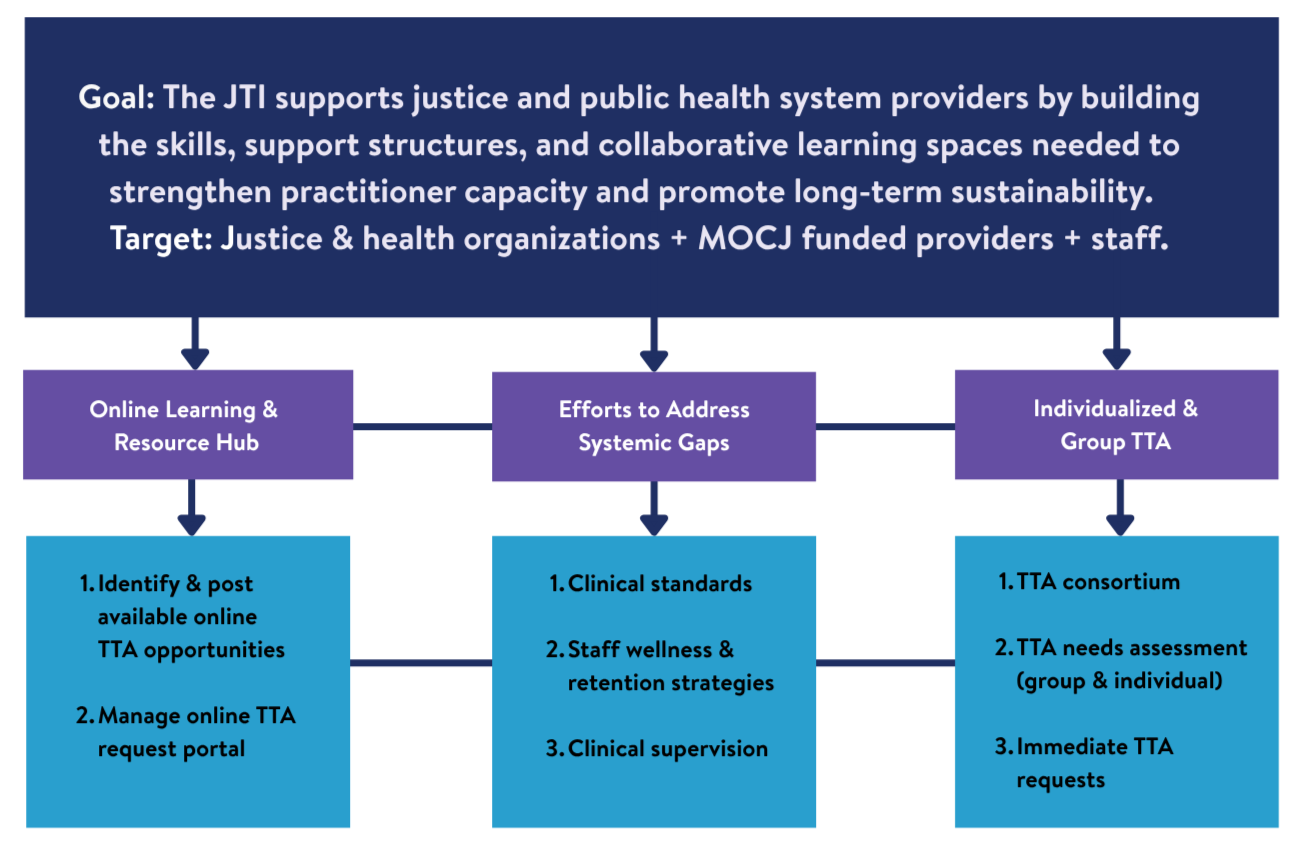
Through the first pillar, the Online Learning and Resource Hub, the JTI provides live and on-demand training and technical assistance, as well as pre-recorded webinars, to MOCJ-funded providers, other city agencies, and health and human services organizations beyond New York City. Through the online hub, providers can request tailored training and technical assistance (TTA ) as needs emerge.
Through the second pillar, JTI seeks to address gaps in the system by working with providers to set standards, retain and train staff, and conduct effective clinical supervision. Our goal is not a one-time boost to these providers but to create self-sustaining systems that can apply these skill sets in the criminal legal system for decades to come. This pillar works with organizations on tailored solutions that will set them up for successful organizational management over the long haul.
Our goal is not a one-time boost to these providers but to create self-sustaining systems that can apply these skill sets in the criminal legal system for decades to come.
Through the third pillar, providers will have access to a continuum of supports that includes group training and workshops, peer and collaborative learning opportunities, individualized technical assistance, and connections to consultants and subject matter experts. This pillar includes the TTA Consortium, a pool of pre-qualified TTA experts from academic institutions, non-profit organizations, for-profit companies, and individuals who can be called upon to offer TTA to support the mission of the JTI. This structure allows the JTI to respond both to common challenges affecting multiple organizations and to individualized organizational or practitioner needs.
Across all pillars of the JTI, we aim to equip providers with practical, real-world skills, including:
Understanding the NYC criminal legal system, including the roles of key agencies and common terms
Developing person-centered case management that addresses both risks of recidivism and behavioral health needs
Learning the basics of mental health, substance use, and co-occurring disorders to better recognize needs and apply best practices, including overdose prevention
Building rapport with clients using trauma-informed care and culturally responsive engagement techniques
Managing crises and de-escalating conflicts, including how to connect individuals to New York City’s crisis response system
Navigating housing, benefits, and workforce systems to provide coordinated support and seamless referrals
Safely documenting client data and using that information to improve services and outcomes
Additionally, rather than beginning with predetermined training offerings, the JTI uses provider feedback and needs questionnaires to identify patterns across the field, distinguish between shared and individualized needs, and develop supports that respond directly to those findings.