
Understanding the relationship between New York State revenues and expenditures as they pertain to New York City can aid policymakers as they consider the historical and policy roots of this relationship, as well as grapple with the many factors that account for budget decisions. The last report assessing these contributions was released in 2010.
This report estimates the “fiscal flow” between the city and state using data from the New York State Fiscal Year 2021-2022 and Census data to estimate taxpayers’ “place of work” as well as “place of residence;” this better reflects economic activity for commuters in suburbs and exurbs.
The study finds that:
New York City contributed 54.5 percent, or $68.8 billion, of state revenues whereas the rest of the state contributed 45 percent, or $57.5 billion. When place of residence is used, New York City contributed 46.7 percent of total revenue
New York City contributes 58.7 percent of New York State’s $70.7 billion income taxes.
New York City received 40.5 percent, or $47.6 billion, of State Operating Expenditures, whereas the rest of the state received $69.7 billion, or 59.5 percent.
New York City’s portion of the state gross domestic product (GDP) has grown by nearly 10 percent since 2010, the last time an assessment of this kind was done. It now sits at 60 percent, compared to 54.3 percent.
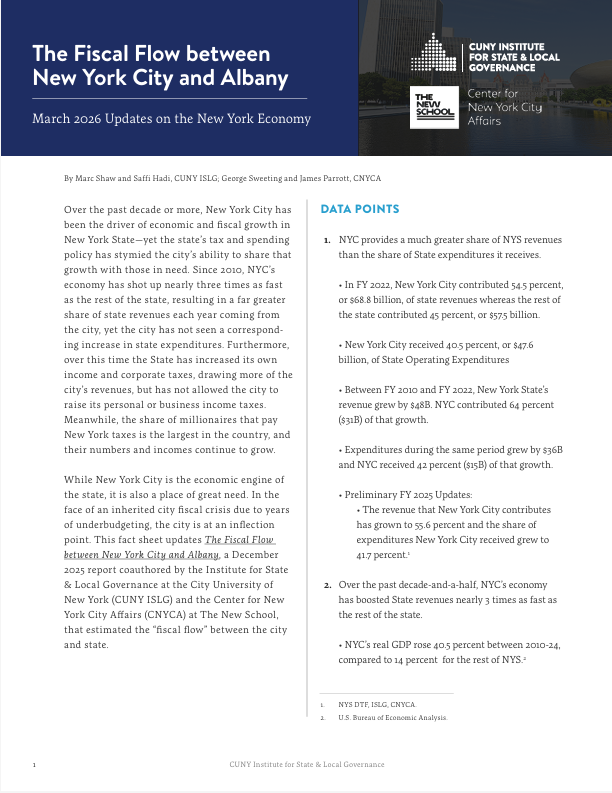
March 2026 Update: This fact sheet provides preliminary FY 2025 updates to the fiscal flow between the city and Albany, including insights that New York City contributes has grown to 55.6 percent and the share of expenditures New York City received grew to 41.7 percent.