
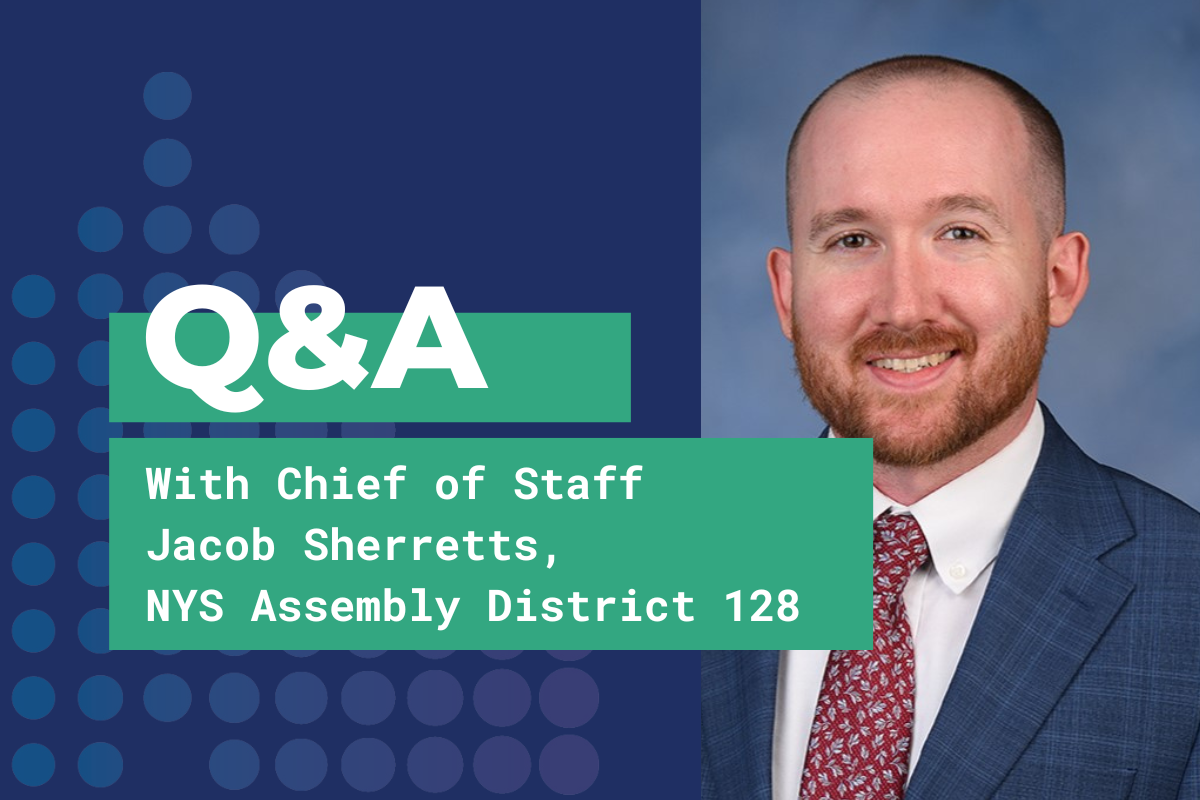
“I serve as a focal point.” Q&A with NYS Assembly Chief of Staff Jacob Sherretts
By Carla Sinclair, Communications Project Director
Chiefs of staff and other legislative office leaders are crucial to the districts they serve, but often operate behind the scenes. ISLG’s Kriegel Fellowship for Public Service Leaders taps into their unique roles to offer professional development and networking opportunities so they can exceed in their current jobs and their future journeys as policy experts. We sat down with one of the Fellows to discuss the role, what Kriegel has offered, the importance of state and local collaboration, and much more.
Whether they’re drafting legislation, tackling policy issues, or out listening to their communities, the chiefs of staff and other legislative office leaders play a vital role in New York City and State. With roles as diverse in responsibilities as the array of public policy issues they delve into, these staff need to be policy experts, legislative wonks, effective managers, and much more.
To support their success as a legislative champion as well as a community advocate, CUNY ISLG established the Kriegel Fellowship for Public Service Leaders in 2020 as a professional development and peer-to-peer learning opportunity for legislative chiefs of staff. The Fellowship has expanded to help all legislative office leaders gain insight into the pressures that influence policy decision-making, enhance their policy knowledge and leadership capacities, and collaborate with peers to more positively impact the future of New York City and State.
ISLG’s Senior Communications Associate, Carla Sinclair, sat down with Kriegel Fellow Jaco Sherretts, who works as the Chief of Staff the New York State Assemblymember Pamela Hunter, to talk about it all.
What is your name and role? What areas does your office represent?
My name’s Jacob Sherretts, Chief of Staff for Assemblymember Pam Hunter, who is currently Speaker Pro Tempore of the New York State Assembly. We represent the 128th Assembly District, which is mostly southern, eastern, and near-west portions of the city of Syracuse, and the municipalities of DeWitt, Onondaga, Salina, Liverpool, Mattydale, East Syracuse, Jamesville, and Nedrow, as well as the Onondaga Nation.
From a municipality and geographic point of view, we have a very diverse district. We have rural areas, we have very urban areas, and then we have the towns, so we get a little bit of everything. It's a pretty interesting district to represent.
Tell me more about what your job entails. What does it look like day-to-day, or week-to-week?
My role is to keep things strategically on point. Some chiefs of staff might be more involved with administrative or staffing issues on a day-to-day basis; in our office, everybody's role is very defined. It's a well-oiled machine. I'm just trying to move towards where the Assemblymember is trying to be, in policy, communications, and the way we serve our constituents. I'm giving feedback to the other members of the staff, and then I'm also serving as a point of escalation if somebody's having an issue or has hit a wall.
In that way, I serve as a focal point, because everybody else on the team is specializing. The chief of staff is the one that needs to bring that all together and make sure it's heading in the right direction. You might have a constituent calling in about something specific, so they’re speaking with your constituent services person; but when they’re asking about legislation, you have to make sure the legislative director and the constituent services person are coordinating. Or oftentimes, there's press inquiries on a bill, and the legislative director knows what the policy is, but then the communications director is more attuned to bringing out the most important information for the public, so they need to be aligned. Sometimes I have more specific duties, with getting on track with a budget deadline or about an upcoming event that we're hosting.
“The chief of staff is the one that needs to bring that all together and make sure it's heading in the right direction.”
Chiefs of staff are the ultimate generalists. You're trying to be a professional generalist. You can't really be an expert in any one area, but you try to know everything you need to know about all the different areas that you're covering. And when you need to learn, what's nice about being in a legislative office is that a lot of experts will volunteer to talk to you about their specialty. I can usually get somebody on the phone or in a meeting to walk me through whatever issue we're delving into.
How did you come to be in public service?
I first heard about the New York State Assembly Internship Program in 2012 through a classmate. I applied for the 2013 session and got my start in Assemblyman David Weprin's office in Queens. It's just funny the way things turn out—I had previously volunteered to do some door knocking for a day with my college’s Democratic club for Assemblyman Weprin when he did his congressional run, and because I had that contact, the Assembly Internship Program assigned me to his office. After the internship, a full-time opportunity as legislative director at his office was available, and I worked there for four years. Then I moved over to Assemblywoman Pam Hunter's office as a legislative coordinator, then legislative director, then policy chief, and now as chief of staff.
Why did you decide to be a Kriegel Fellow?
I've worked alongside chiefs of staff throughout my last decade in legislative offices, but never before had been one myself. Being a chief of staff is definitely different than observing what other people do. Nobody gives you a handbook and says, “this is how you should be chief of staff for this office.” Each district has different needs and different personalities. But every office is ultimately accountable to the voters. They're making specific decisions based on their voters’ specific needs. And each legislator handles those demands differently. A legislator from the North Country is going to have to respond to different needs in their office and how they want to staff things than somebody from Queens. It's just going to be a different experience. Hearing all the varying perspectives in the Fellowship helps facilitate whatever your own strategy is.
“Nobody gives you a handbook and says, ‘this is how you should be chief of staff for this office.’ Each district has different needs and different personalities. But every office is ultimately accountable to the voters.”
It’s also been useful because my past experiences had to do with managing the Assemblymember’s legislation, and now I'm more in a role where I have to offer supervision and coordinate the staff; I was looking to focus on that. Early in the Fellowship, we did have a session on that, which was helpful. There were also sessions on utilizing census statistics and affordable housing that were very insightful.
How has your experience in this Cohort been so far?
It’s been interesting seeing how other offices handle things. Since I'm in Central New York, just seeing what the demands are for, say, a New York City member, has been enlightening. And some of the connections I've made have also been good and surprising. I've worked in close proximity to certain people throughout the years, but we've never really connected, and the Fellowship gives you a platform to do that. I've found that very valuable.
It’s also been useful to see things from the New York City perspective. I’ve worked nearly a dozen New York State budget cycles, but I've never really seen it from the New York City budgeting perspective. Having budget veterans come in and talk to the Fellows about it was very helpful, because even though it's the state budget, there are things going on in the New York City that can take some bandwidth with the process. A better understanding of what the City’s fiscal needs are and how they approach it was pretty important, and it gave some context to things that we’re more directly involved with on the state level. For instance, the MTA: there has to be a big discussion about how we are funding the MTA. That's mostly a New York City issue, but has to be handled on a state level. So now I feel like I'm getting more of the whole picture of how that's being processed.
What does it mean to have this community of legislative staff members from other offices, both as Cohort colleagues and Fellowship alumni?
It makes the job less frustrating. It makes you realize that these issues we’re all dealing with are gigantic, and they’re not going to be solved in one meeting, in one memo. Having connections with people who are dealing with the same things, the same challenges, makes things clearer.
It’s also useful to network and meet people. Having someone you could shoot a question at, knowing they're dealing with the same situation.
What do you hope to take away from the Fellowship overall, and apply to wherever your path takes you?
The chief of staff role is a generalist role, so what we're taking away from the Fellowship can be helpful in whatever path you take. It’s already given me a scaffolding in how to approach new challenges, being more involved in managing staff, and how to optimize everything we're working on.
You take in a lot of information during these sessions, but it takes time to put it into practice. That’s something I’m looking forward to after the Fellowship. I can really sit down, go through all the materials, refresh myself with the notes, and then actually have one-on-one meetings with different members of the staff and see how we can optimize what they're working on.
Do you think it’s important to have learning and networking opportunities for public service leaders? Why?
Like we talked about earlier, this role can really vary from office to office. Just having this network impacts what information you can bring in. You might find something from someone else's experience is applicable to your challenges in an unexpected way, because there isn't a prescribed way of dealing with the problem. There are no guidelines for how you work through challenges, so having these networking opportunities is invaluable.
“There are no guidelines for how you work through challenges, so having these networking opportunities is invaluable.”
A lot of the aspects of this job are based on relationship networks, knowing who is informed on how to solve a problem. Maybe this other chief of staff handled something that's similar, or this person has a contact in this field who'd be open to sharing their knowledge with legislators. I don't think anyone could ever have a truly full Rolodex. There's always somebody else who knows someone, or at least knows who to reach out to.
What is something you wish people knew about the folks who work behind the scenes in legislative offices like you?
How much there is to the legislative process before it gets to the point of a floor vote. I think in the public's mind, the legislative process starts when policymakers are asking, “Does it have the votes? Is it going to pass?” But oftentimes, because of the way the legislative process is structured, they have been deliberating the issue for months or even years. There's a much longer tail to the legislative process.
Members of the public can use that to their advantage. Because when things are at that critical vote-counting point, and somebody is sending out emails to “go call your legislator,” that’s when we're being inundated. That's when we actually have the least bandwidth. You should think about meeting with your legislator in the summer, when they can get a better understanding of what your viewpoint is, or what your needs are. The legislative process can be dense, and meeting with your legislator and making your perspective known outside of the budget process time is a good way to get more out of the process.
Image provided by Jacob Sherretts, designed by Carla Sinclair.