“A Swiss Army knife for our district.” Q&A with NYC Council Deputy Chief of Staff Julian Martin
By Carla Sinclair, Communications Project Director
Chiefs of staff and other legislative office leaders are crucial to the districts they serve, but often operate behind the scenes. ISLG’s Kriegel Fellowship for Public Service Leaders taps into their unique roles to offer professional development and networking opportunities so they can exceed in their current jobs and their future journeys as policy experts. We sat down with one of the Fellows to discuss the role, what Kriegel has offered, the importance of state and local collaboration, and much more.
Whether they’re drafting legislation, tackling policy issues, or out listening to their communities, the chiefs of staff and other legislative office leaders play a vital role in New York City and State. With roles as diverse in responsibilities as the array of public policy issues they delve into, these staff need to be policy experts, legislative wonks, effective managers, and much more.
To support their success as a legislative champion as well as a community advocate, CUNY ISLG established the Kriegel Fellowship for Public Service Leaders in 2020 as a professional development and peer-to-peer learning opportunity for legislative chiefs of staff. The Fellowship has expanded to help all legislative office leaders gain insight into the pressures that influence policy decision-making, enhance their policy knowledge and leadership capacities, and collaborate with peers to more positively impact the future of New York City and State.
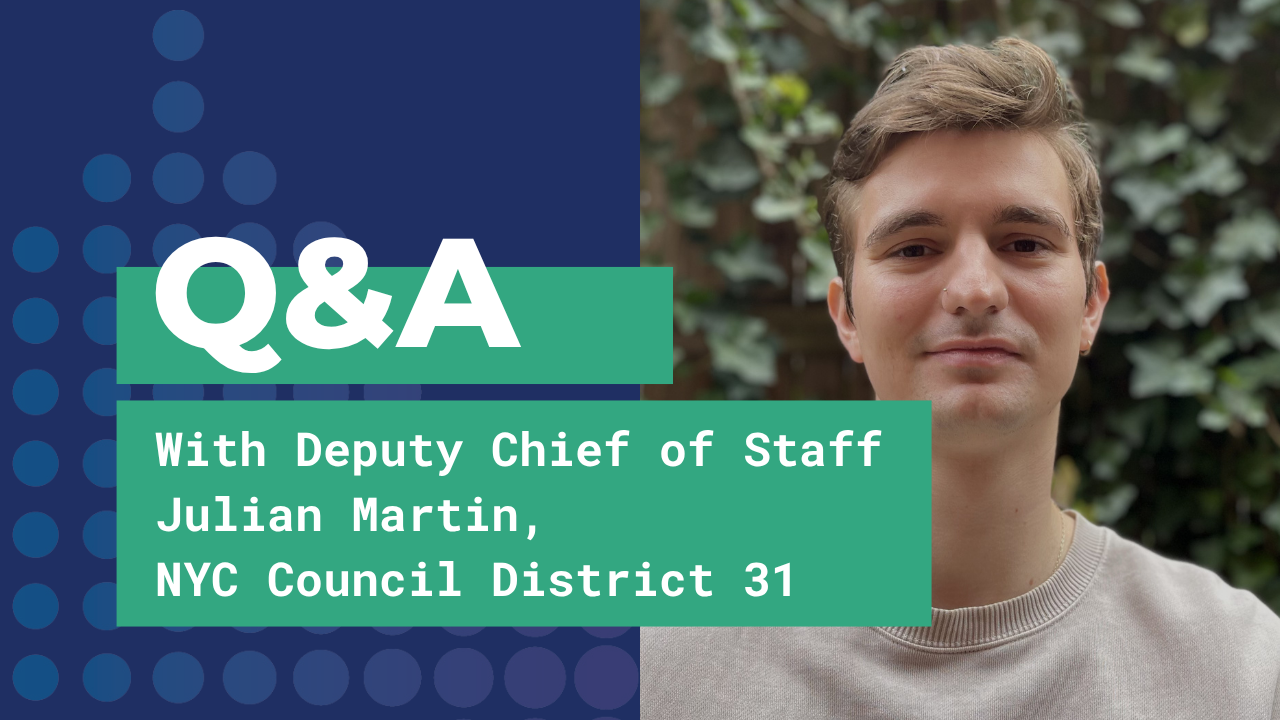
ISLG’s Carla Sinclair sat down with Kriegel Fellow Julian Martin, who works as the Deputy Chief of Staff the New York City Council Member Selvena N. Brooks-Powers, to talk about it all.
What is your name and role? What areas does your office represent?
My name is Julian Martin. I'm Deputy Chief of Staff for Council Member Selvena N. Brooks-Powers, who represents the 31st Council District in New York City. The 31st Council District includes the eastern portion of the Rockaway Peninsula and parts of Southeast Queens around JFK airport. On the Rockaway side, that includes neighborhoods like Arverne, Edgemere, and Far Rockaway. On what we call the mainland portion of our district, we have Brookville, parts of Springfield Gardens, Laurelton, and Rosedale.
My Council Member always says that our district is the furthest point in the city from the Central Business District of Manhattan, so a lot of our work is focused on transit equity and making sure that our district is invested in and connected to the same opportunities and resources as other neighborhoods across the city.
Tell me more about what your job entails. What does it look like day-to-day, or week-to-week?
It's honestly hard to describe in a snapshot, because so much of what I do varies week to week. Overall, my role is to work as a sort of Swiss Army knife for our district. My primary responsibility as Deputy Chief of Staff is to help be a connector between our district and City Hall, and I split my time in both to do so.
In my role specifically, I handle legislation, budget, land use, press, and constituent matters as they come up. The work can be anything from organizing a rally on the City Hall steps for a bill we're trying to advance, to meeting with community organizations. We fund over 100 community organizations that provide services to constituents in our district, so I meet with those organizations alongside the Council Member and facilitate that budget process.
“Overall, my role is to work as a sort of Swiss Army knife for our district.
My primary responsibility as Deputy Chief of Staff is to help be a connector between our district and City Hall.”
I also help facilitate our legislative process, support the Council Member in advancing key legislative priorities, and help manage the ULURP process when we have land use applications in our district. That involves a lot of community input and negotiations between our office and the applicant. Really, I'm trying to make sure we’re staying on top of all that work, and making sure I'm elevating the Council Member's voice across all those areas.
Why is this role important?
Every district office in the Council has a limited budget and limited staff. My role—not just for my specific office, but in Council Member offices across the city—is important for making sure we are connecting the realities and lived experience of the people in our districts to the legislation and budget priorities being discussed and moved forward at City Hall.
This means I provide support to the Council Member in negotiating legislation with a broad range of stakeholders. And once we're able to advance legislation or bring community members along to elevate their voices, we work to get the news out about what we've accomplished—whether that's new legislation passed by the Council or new funding opportunities for our district. It's important to have somebody working within city government, specifically within the council, who is able to be a connector between what we hear on the ground and make sure that’s reflected in the reality of our government.
There are so many things going on in the world, we want to make sure our constituents and New Yorkers are aware of the work that the Council is doing in legislation that impacts their day-to-day lives. I can give you an example. This year, Council Member Brooks-Powers sponsored Intro 1297, the Gender-Motivated Violence Protection Act, which provided survivors a pathway to justice against individuals and institutions alike—including the Epstein Estate, city agencies, and others. That was a really significant piece of legislation that we passed to help give survivors legal recourse.
Now that it's passed, we're getting calls from constituents who want to know their options, who may be survivors themselves and want to be connected to legal resources. So myself and others in the office are now working on the back end to connect folks in our district and across the city to legal services.
Overall, my role can be hard to pin down, but it’s often trying to fill in the gaps between the legislation we pass and the community we serve.
“My role—not just for my specific office, but in Council Member offices across the city—is important for making sure we are connecting the realities and lived experience of the people in our districts to the legislation and budget priorities being discussed and moved forward at City Hall.”
How did you come to be in public service?
I've always been interested in public service. I always knew that professionally I wanted to work in government, though I didn't know exactly what that would look like.
I grew up in the city, left for college, and worked a few years internationally. Then I decided I wanted to come back and work in city government and serve the city that raised me.
I came back to New York and got a job with the New York City Economic Development Corporation (EDC) on their economic research and policy team. That was my first full-time professional experience working for the city, and it opened my eyes to so much of how our government operates, all the work that the City is responsible for doing, and how much work there is to do. I was at EDC for a bit, then transitioned to my current role on the Council.
Like with any career, a good amount of my trajectory has been partially luck, partially timing, and partially the people I know who've connected me with others. I can't tell you that 10 years ago I knew exactly I'd be in this role that I am today, but I did have a general sense of wanting to be in public service in local government in New York City and to do community-focused work . I feel super lucky.
Why local government, versus state or federal?
When I was younger, I was interested in federal government. But what ultimately drew me to local government is that I think one of the biggest issues government deals with across all levels right now is trust. There are a lot of people who have lost their trust in government. Though there is still a lot to build, local government has shown to be where there is the most trust, and I think the reason for that is a tighter feedback loop between the work that we do and the response we get from the community, whether it’s legislatively or through constituent services.
“Local government has shown to be where there is the most trust, and I think the reason for that is a tighter feedback loop between the work that we do and the response we get from the community.”
If we make a mistake, or if we do something our constituents love, we will hear about it directly and immediately, and can course correct if needed. As you move up to higher levels of government, that feedback loop can become weaker in some cases.
For me, I wanted to work in an environment where I would hear directly from the people impacted by whatever I'm working on. For government to be effective, there needs to be that clear line of accountability, and that's what attracted me to local government. It can make the work very difficult sometimes, but ultimately it's all worth it, because those of us who work in government want to make sure that whatever we're doing is ultimately advancing the public good. And if you're not hearing from people directly, it's hard to know if you're going in the right direction.
Why did you decide to be a Kriegel Fellow?
Government work is super demanding, and you learn how to do it on the job. There are not as many opportunities in public service as there are in other sectors to get professional development or mentorship and structure on how to handle what you’re working on in the Council or in any other government body.
For me, the Kriegel Fellowship was an opportunity to do two things. First, to get really concrete learning opportunities. Through our sessions, we hear directly from experts and get hands-on professional development. And second, to connect with other people in the cohort. So much of the work we do in the Council and in local government overall is relational. Your network, being able to call someone up to help solve a problem, is really important to getting your work forward. Having other people in the same space means we can all do our jobs more effectively, because we know each other. And it's an amazing learning opportunity to hear from people in similar roles from across the city and state who are facing many of the same issues we face, but approaching them from a totally different perspective.
Both from a professional development standpoint and from a networking standpoint, that's really what I came for, and what I've been able to get as a Kriegel Fellow.
Were there any particular session topics that spoke to you, or a specific policy issue you wanted to address through the Fellowship?
The sessions that stood out most to me were the ones on the state budget. In addition to the things we discussed above, one of the main reasons I wanted to join Kriegel was to get a better understanding of how things work at the state level. At the Council, we work on the City budget process and with City agencies, but at least in my role, we don't work nearly as much with our partners in Albany.
Learning what that state budget process looks like, how the two legislative bodies interact with the Governor’s Executive Chamber, how the state disperses funds, and how so much of the State budget is actually a pass-through to local municipalities. Hearing from people who worked for the State at the highest levels of leadership for decades was eye-opening.
People always say the budget is a reflection of a state's or city's values, and getting into the nitty-gritty of how that sausage is made is really complex, but really important if you want to get anything done.
How is your experience in the Fellowship so far?
It's been great. The highlight for me has been the people I've met, folks I maybe knew before but have gotten to know better, State partners I didn't know before, people from City agencies I wasn't familiar with. Getting that breadth of experience and perspective has been really valuable.
Often the most interesting part of our sessions is the Q&A, when I get to see what other fellows are thinking about, what issues are coming up in their districts and how that relates to whatever our focus is for the week. That makes me think about the issues in our own district in a different way through having a back-and-forth about a particular issue.
So much of the value for me has been learning from the other people in my cohort, learning about what their work is like, and realizing that we're all asked to do a lot in our positions. It's really helpful to know there are other people going through similar things, and that we can be a resource to each other.
Do you think it's important to have these kinds of learning and networking opportunities for public service leaders more broadly?
I think it's so important because resources are scarce in the public sector, and there are not a lot of opportunities for professional development when you're working in local government. Having a structured setting where you can come in every couple of weeks and just learn is rare. It’s really rare.
“Having a structured setting where you can come in every couple of weeks and just learn is rare. It’s really rare.”
So much of what we do in these roles, we learn on the job. But it's really helpful to have a sense of what best practices are and to hear from people who've been working in the field for their entire careers, in some cases for decades. It gives you the kind of learning that, without opportunities like this, would also take you decades to get on your own. These types of structures and organizations provide the opportunity to accelerate that learning in a way that we don't get otherwise.
And it works the other way, too. We've had conversations with experts where we bring up issues they've never thought of before. There really aren't that many forums like this in our line of work, so it's meaningful to be able to bring people together and put ideas out there. I'm not really aware of many other spaces that provide the opportunity to do that.
What do you hope to take away from the Fellowship overall, and apply to wherever your path takes you?
One thing I hope to carry forward is the other Fellows and the network we've built. I'm sure as the years go on people will change roles, but it's good to know that if things come up, we have this network and can call on each other for support, guidance, questions, or whatever we need. In the world that we operate in, things can come up at any minute, and having people you can rely on helps us respond to our constituents.
I'll also carry with me a broader sense of how much you can do in government. We have folks who represent different districts who, even in similar roles, do very different types of work. From a professional development perspective, seeing how this line of work will always provide new opportunities for learning and growth, and also that there’s just so much to be done.
Hearing from other people working in government has inspired me to keep working for the city, keep serving New Yorkers. The stories I hear from the people in the Fellowship about the work they do just inspires me to work harder and continue the work.
What is something you wish people knew about the folks who work behind the scenes in legislative offices like you?
If there's one thing I could say, it's that so much of the work we do—legislatively, with the budget, with any of our top priorities—is bottom-up. What I mean by that is we'll hear an individual case from a constituent, someone will call into our office with a concern, and that can turn into an idea for a bill. So much of what we do is directly tied back to community input we receive.
So I guess that’s an appeal to the public: get involved with your local elected office, make sure your voice is heard. I understand that people sometimes get disillusioned with government, and I understand the reasons for that. But I'd also ask New Yorkers, and the broader public, to remember that our offices are an opportunity for you to come forward with ideas. We're always open to proposals about how we can turn the issues New Yorkers are facing into real solutions. That's the bread and butter of the work we do.
“We're always open to proposals about how we can turn the issues New Yorkers are facing into real solutions. That's the bread and butter of the work we do.”
Image provided by Julian Martin, designed by Carla Sinclair.