
RESOURCES
Knowledge Center
Outcomes, discoveries, and analysis from our breadth of good governance initiatives.

The Inside the New York Budget Process series breaks down the formal and informal steps in the New York State and City budget processes.

As New York City launches the first phase of free child care for two-year-olds, and Governor Kathy Hochul pledges to expand universal child care across the state, CUNY ISLG explored the potential return on investment for a hypothetical statewide program that would cover every child from age six weeks up. Such a program would have positive economic, labor, and social impacts.
Nearly half of all women who are incarcerated are held in local jails. Despite work reducing the rate in which they are incarcerated, trends post-pandemic are trending upwards, especially when compared to men and significantly when looking at women of color. Looking at data from across the country, this brief provides insight into these trends and why it matters.

Across American counties, cities, and states, immigrants—both documented and undocumented—have innumerable socioeconomic impacts on the communities they now call home. To better understand these impacts, CUNY ISLG has analyzed research on three key indicators of a thriving community: economy, health, and safety.
Reflecting on the past decade of work, this series of briefs take stock of CJII’s goals in key areas, dives into case studies of the real-life impact community organizations achieved, and provides a blueprint for practitioners, researchers, policymakers, and funders to shape the future of public safety partnerships.

Many Safety and Justice Challenge sites report evidence of racial and ethnic disparities at different decision points in their case processing. Yet, they have less information about how disparities at one decision point can impact disparities at subsequent ones. It was clear that more research was needed into how disparities can compound across decision points and create cumulative effects.

Courts play a central role in local criminal legal systems, shaping the experiences and outcomes of people who face legal charges. Using data collected as part of the Safety and Justice Challenge, ISLG researchers explored how case processing time changed during and after the COVID-19 pandemic in response to public health restrictions and reduced court operations with data from 10 participating SJC jurisdictions.
As part of the SJC, New Orleans and Lucas County, Ohio, implemented tailored strategies to safely reduce jail populations, including a Public Safety Assessment. The Center for Justice Innovation examined whether the PSA managed to reduce jail populations without sacrificing community safety; they found that not only did it not increase crime, but recidivism rates generally decreased.
This report captures not just some of what we produced in 2025, but how we worked—and why these approaches matter.

The Hub connects practitioners and policymakers around the country with the research and tools they need to innovate and improve the fairness and effectiveness of pretrial and jail-related decision-making and outcomes.
This report estimates the “fiscal flow” between the city and state using data from the New York State Fiscal Year 2021-2022 and Census data to estimate taxpayers’ “place of work” as well as “place of residence;” this better reflects economic activity for commuters in suburbs and exurbs.
This ROI analysis assesses the impact of raising wages for the lowest paid human services workers on local economies, on the stability and well-being of individuals and their communities, and what it would mean for the sustainability and service provision of human services as a sector.

To learn more about decision-making processes among public safety communications professionals and influences on responding law enforcement officers, CUNY ISLG funded Arizona State University (ASU) and the University of Missouri-St. Louis (UMSL) through the Safety and Justice Challenge (SJC) to conduct a mixed methods study.

Cities and counties in the Safety and Justice Challenge have engaged in multi-agency efforts to safely shrink their local jail populations by nearly 18,000 people. Importantly, people released pretrial were no more likely to return to jail than before the SJC, including for violent crime. In this report, CUNY ISLG analyzed individual-level jail data from 5 participating counties to explore trends.

Through CJII funding, NYU-CUNY Prevention Research Center (PRC) conducted an outcome evaluation of the NYC Health Justice Network program. The final report findings offer preliminary evidence of NYC HJN’s ability to reduce future criminal legal system involvement among participants.

This study on the College-in-Prison Reentry Initiative (CIP), a program to expand access to college education in prison throughout New York State. This study improves on and updates existing literature by measuring recidivism and examines the impacts of education on several outcomes, including in-facility behavior and post-release income.

This Yearbook was created to acknowledge a year’s worth of incredible work from the 16 Community-Based Restorative Justice program grantees during the End-of-Year Community Forum, a two-day gathering of grantees, philanthropy partners, and restorative justice practitioners on June 16th and June 17th, 2025.

CUNY ISLG funded Justice System Partners (JSP) to conduct mixed-methods studies in Cook (IL), Lucas (OH), and Multnomah (OR) counties, where local defense agencies had led programs to systematically enhance due process for individuals at initial appearance.

Drawing from a wealth of experience developing service navigation programs as well as research on data-informed, community-responsive approaches, this brief provides a guide to developing navigation programs that can help government and public institutions connect communities with care, creating safety and opportunity for all.

The CUNY ISLG study examined police encounters recorded by BWCs over a two-month period in 2022 to assess how frequently stops were constitutional. The study also assessed whether police were appropriately documenting stops.
Despite the importance of these services, wages in the human services sector lag behind the cost of living in New York, straining the pipeline of people entering and staying in these careers, and forcing many workers to experience the same financial and wellbeing strains as the people they serve.
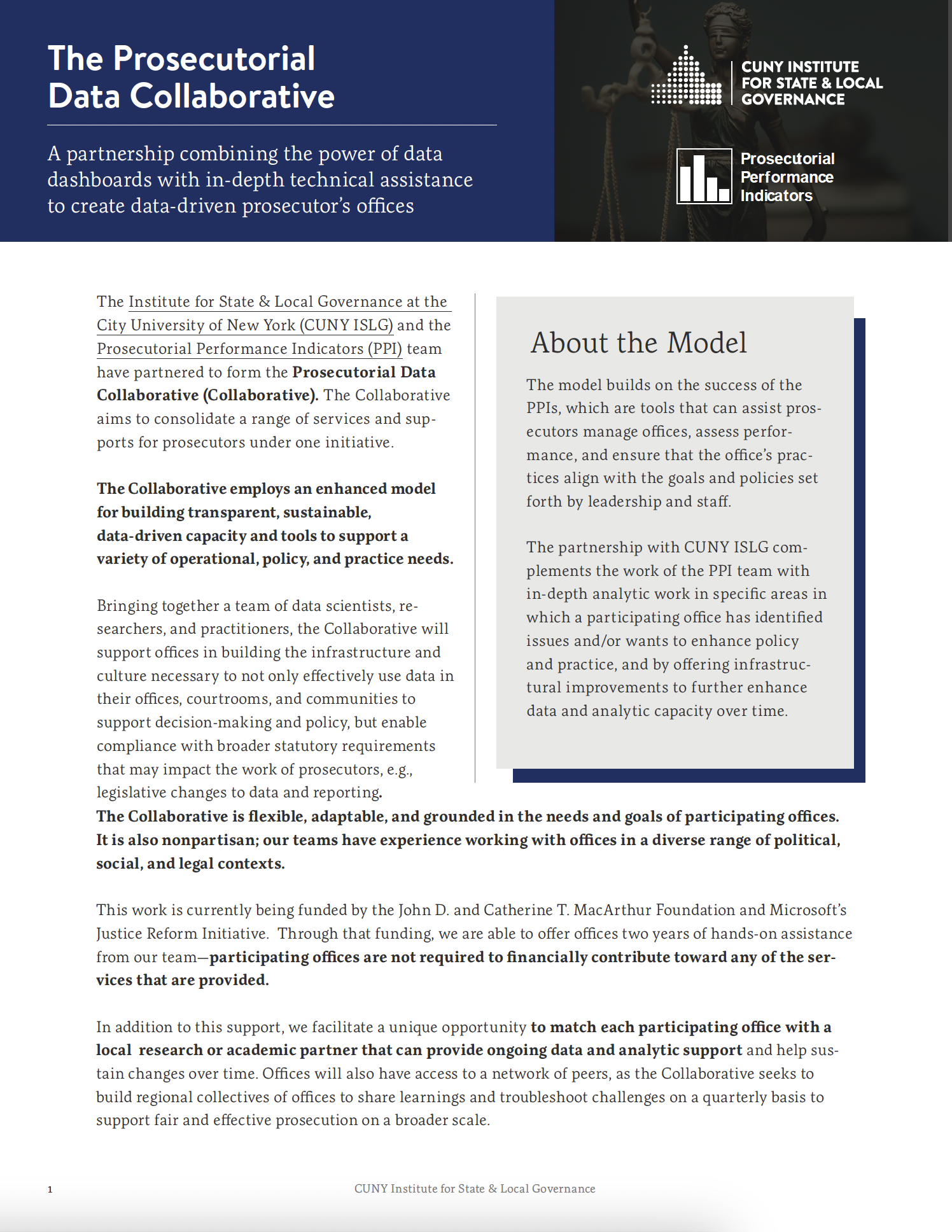
Bringing together a team of data scientists, researchers, and practitioners, the Collaborative supports state and local prosecutors in building the infrastructure and culture necessary to not only effectively use data in their offices, courtrooms, and communities to support decision-making and policy, but to enable compliance with broader statutory requirements.

This brief showcases how learning communities can be used to support innovation, growth, and collaboration among organizations working toward shared outcomes. The Center for Trauma Innovation, a CJII-funded project, is used as a case study.
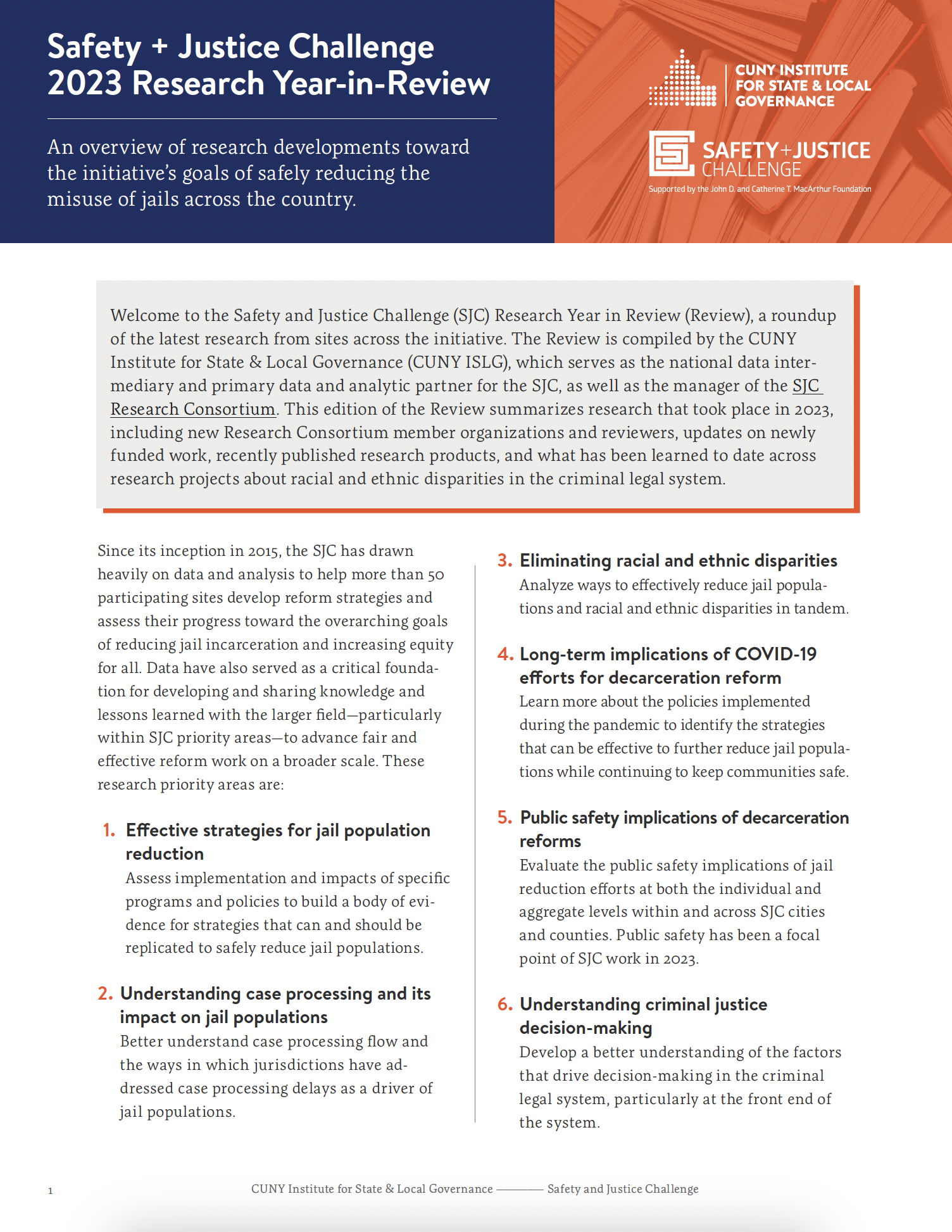
This edition of the Review summarizes research activities that took place throughout 2024, including new Research Consortium memberships, updates on newly funded work, and recently published research products, with a spotlight on women and survivors of violence in the criminal legal system.

To learn more about the impact of emergency COVID-19 measures on jail reduction efforts, and think about emergency measures that could continue in the post-pandemic era, CUNY ISLG funded JSP through the SJC to conduct a mixed-methods case study on the emergency jail population reduction strategies implemented in Multnomah County, Oregon.

Through credible messengers, restorative justice, and a capacity-building incubator, WHCRRP provided direct services to those in Manhattanville and the Grant Houses and surrounding area in the West Harlem community.
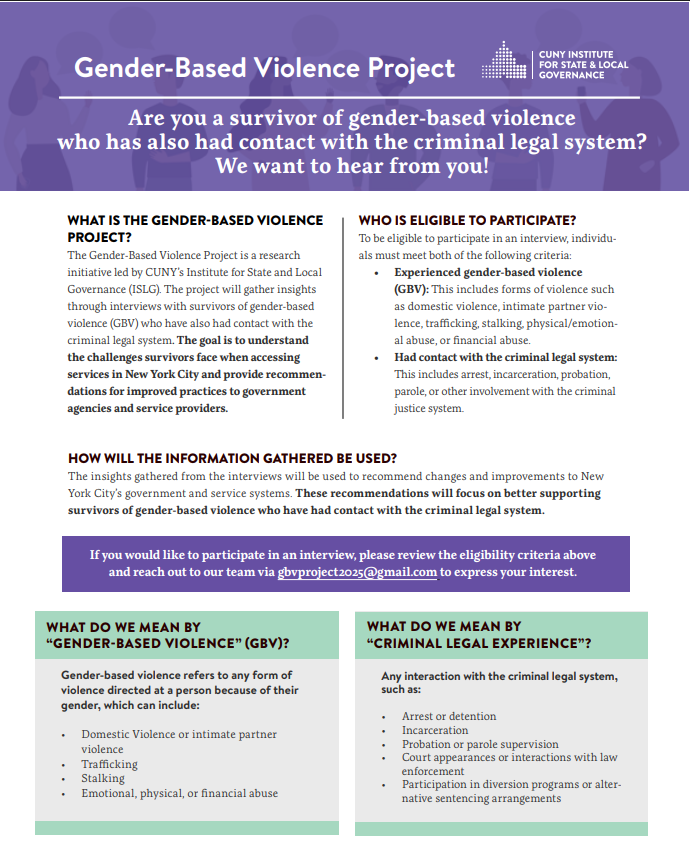
The project will gather insights through interviews with survivors of gender-based violence (GBV) who have also had contact with the criminal legal system. The goal is to understand the challenges survivors face when accessing services in New York City and provide recommendations for improved practices to government agencies and service providers.

This brief details how CUNY ISLG staff work with governmental agencies, nonprofit organizations, and other partners to effectively collect, maintain, and use data, especially in the face of time and resource constraints.

Reflecting on the past decade of work, this model brief takes stock of these four CJII goals; discusses how DANY, CUNY ISLG, and other partners achieved them; and provides a blueprint for practitioners, researchers, policymakers, and funders.
The Safety and Justice Challenge (SJC) Research Year-in-Review is a roundup of the latest research from sites across the initiative. The Review is compiled by CUNY ISLG, which serves as the primary data and analytic partner for the SJC, as well as the manager of the SJC Research Consortium. This edition of the Review summarizes research activities that took place throughout 2025, including updates on newly funded work, recently published research products, and work to synthesize findings across the SJC.