
Universal Child Care Pays Off: Government Investment in Child Care Would Bring Billions to New York’s Families and Economy
As New York City launches the first phase of free child care for two-year-olds, and Governor Kathy Hochul pledges to expand universal child care across the state, CUNY ISLG explored the potential return on investment for a hypothetical statewide program that would cover every child from age six weeks up. Such a program would have positive economic, labor, and social impacts.
By Cecilia Low-Weiner, Senior Research Associate, Lisa McMonagle, Senior Policy Associate, and Stephanie Rosoff, Deputy Research Director
This fall, for the first time, two thousand New York City two-year-olds will start their first day of school in the nation’s largest free 2-K program. A key part of Mayor Zohran Mamdani’s agenda, and enacted with support from Governor Kathy Hochul and the State legislature, this new program is aimed at addressing 2026’s top political watchword: affordability.
Paying for child care during the first five years of a child’s life, before public school begins, has become one of the most expensive items in a family’s budget. Nationwide, child care prices have risen 41 percent in a decade, faster than inflation. This is especially true since the pandemic, with child care costs increasing due to both rising costs and the post-pandemic collapse of the child care workforce.
The US Department of Health and Human Service’s definition of affordability determines that child care should costs no more than 7 percent of a family’s yearly income. In New York City, estimates suggest up to 80 percent of families cannot afford it. The current mechanism to subsidize child care, the Child Care and Development Block Grant, only supports around 10 percent of eligible families, leaving the vast majority without the needed support. In New York, center-based care for infants averages $20,978 annually ($1,748/month), while home-based care costs $16,848 annually ($1,404/month). This can represent 50 percent of a median single-parent family's income—and it’s twice the cost of a year at CUNY.
These high child care costs have real consequences for communities and families. Unaffordable child care strains family budgets, especially as food and housing costs have sharply risen. The high cost of child care can also push families into poverty; prevent parents, especially mothers, from participating in the workforce; and stifles economic growth in the form of reduced tax revenues and local economic activity. Further, the lack of affordable early education through this care limits access to the meaningful socio-emotional, academic, and financial benefits these programs provide.
Child Care as a Policy Priority for State and Local Governments
Publicly funded child care has gained traction as a policy priority in the past few years. In New York State, Governor Hochul has taken steps to respond to the crisis: this year’s New York State budget included $4.5 billion for child care and prekindergarten statewide. These investments included $73 million to launch NYC’s 2-K program in select districts (which is anticipated to grow in size and in funding to $425 million next year), funding to make pre-K universal throughout the state, and support for child care workforce development. These statewide investments expand on New York City’s universal preschool programming for three- and four-year-olds, which provide care for some 92,000 children each year.
State and local governments across the country are also headed in this direction; notably New Mexico, Connecticut, and Vermont have moved towards statewide policies that fully or significantly fund early childhood education.
-
In this report, we are using the term universal child care to mean free child care for all families, regardless of income, immigration status, ZIP code, or any other demographic marker. This doesn’t mean that every child would take part in universal child care, but that it is accessible and free to all.
Fully implementing universal child care across New York State is expensive, with estimates for the City alone reaching $9 billion annually. The investment, though, has the potential for a significant return to families and all New Yorkers. This research brief by the Institute for State & Local Governance at the City University of New York (CUNY ISLG) lays out the economic, workforce, and social returns of investing in universal child care across New York State. In all, our analysis suggests that funding universal child care results in a significant return on investment, both economically and socially.
Key findings from our research include:
Economic Impact: Billions in Savings for Families, Economic Activity, and Tax Revenue
Implementing universal child care may increase labor force participation by as many as 28,000 additional workers, leading to as much as $1.6 billion in additional wages across the State.
In turn, this additional labor force participation may bring up to $35.4 million to $70.9 million in additional income taxes each year. Additional sales tax revenue (from increased spending) is estimated at an additional $40.1 million to $67.7 million. This increase in labor participation could generate $1 billion to $3.1 billion in additional economic activity.
Families could save an estimated $8.3 billion on child care, which could generate up to $16.5 billion in additional economic activity.
Workforce Impact: Retaining and Advancing Workers, Reducing Turnover
Research shows that child care challenges forced 34 percent of working mothers in NYC to choose part-time work or decline promotions, while 29 percent left the workforce entirely. Affordable child care would help retain these workers and support career advancement.
In NYC, reductions in employment due to child care access resulted in $23 billion in lost economic output, $5.99 billion in reduced disposable income, and $2.2 billion in lost city tax revenues.
Turnover rates among workers with children under 5 are higher than other workers, with replacement costs ranging from .5 to 2 times an employee’s salary. NYC employers could gain $900 million annually from reduced turnover and absenteeism.
Social Impact: Stable Families, Better Childhood Outcomes
Universal child care represents one of the most effective government investments, primarily through improving social and economic outcomes for low-income children, with estimated annual rate of return of 7-10 percent through better education, health, and economic outcomes.
Quality early childhood education leads to increased educational attainment, higher future earnings, and improved overall health outcomes.
Universal child care increases family stability; there are high lifetime costs to leaving the workforce to care for children (the “motherhood penalty”). Further, universal child care increases the well-being of mothers who were previously constrained by lack of child care access, reduces stress, and improves overall family stability.
Estimating the Return on Investing in Child Care
To model the potential return on investment (ROI) of establishing universal child care in New York State, we broke our research into three parts: estimating the economic impacts of universal child care, estimating the impacts on the workforce, and estimating the social impacts.
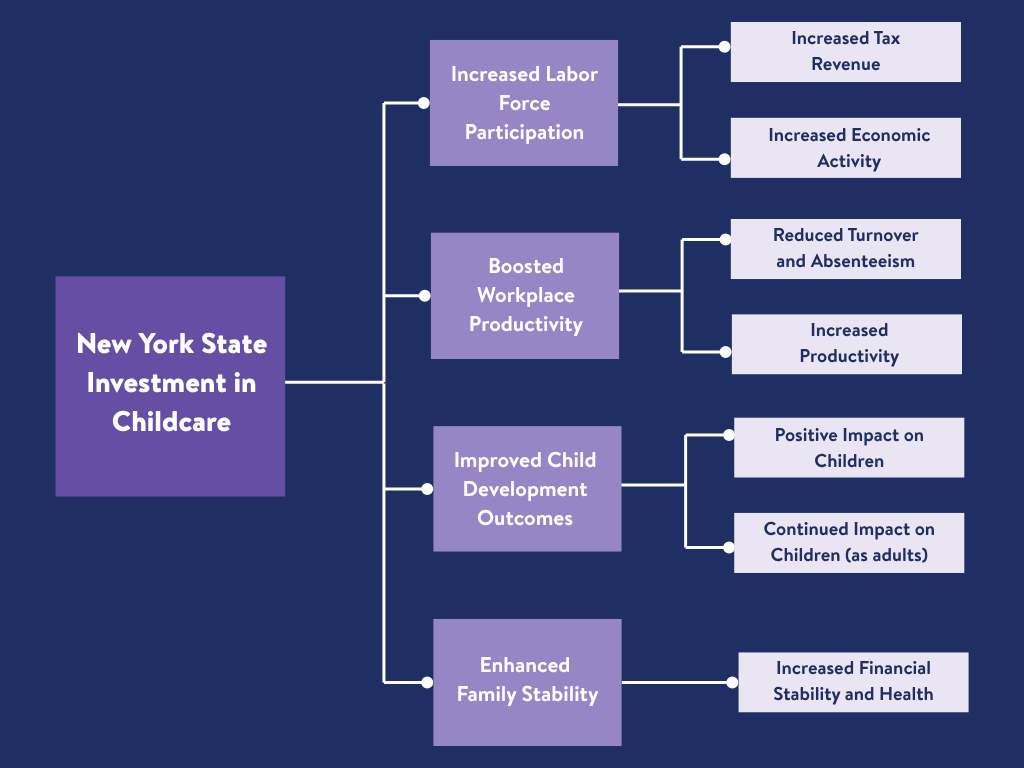
Research indicates that the failure to invest in affordable child care has depressed economic growth. By contrast, a significant investment in child care would yield positive benefits to the local economy, the State’s workforce, child development, and family stability. Figure 1 illustrates the ways in which investing in universal child care impacts different dimensions. Key findings are detailed for each section throughout the brief.
Figure 1: Summary Diagram of Return on Investment
Part I: Estimating Economic Impacts
Part I of this brief looks at the economic returns the State might expect with the implementation of a universal child care policy. To do this, we explore the impact of (1) increased tax revenue and economic activity as a result of an increase in labor force participation following the implementation of universal child care; and (2) increased economic activity associated with boosted household discretionary income recouped from reduced child care expenses.
Implementing universal child care may increase labor force participation by as many as 28,000 additional workers, leading to as much as $1.6 billion in additional wages across the state.
Labor force participation is a function of both child care availability and child care costs (relative to income). If child care costs are reduced or eliminated, there will be an increase in labor force participation for women, especially lower-income women, who see a larger drop in their employment rates when they become mothers. We have early evidence of this from NYC’s expansion of pre-K; early reports showed a 7.5 percent increase in maternal employment following the rollout of universal pre-K. In international examples, we see increases in maternal labor force participation at rates of 5 to 10 percentage points. Labor force increases have wide-ranging implications, including expanded workforce, increased income, taxes, and economic activity.
Increased labor force participation of approximately 28,000 people following universal child care could lead to as much as $1.6 billion in additional wage earnings across New York.
Estimates produced by the Century Foundation are even higher than the ones derived from our analysis; they estimate that New York could see $3.2 billion in additional wage earnings for parents entering the workforce, or increasing hours, under universal child care. [i]
In turn, this additional labor force participation may bring up to $35.4 million to $70.9 million in additional income taxes each year. Additional sales tax revenue (from increased spending) is estimated at an additional $40.1 million to $67.7 million. This increase in labor participation could generate $1 billion to $3.1 billion in additional economic activity.
Increased labor force participation promises not only benefits for individuals and families but also measurable benefits to the State. Additional wages from this increased employment flow through the economy, both in terms of direct benefits to the State (income and sales tax), and broader economic activity (explored in the next section).
Income Tax: Approximately 28,000 workers may enter the workforce as a result of universal child care. Assuming an effective state income tax rate of 4.5 percent, the potential additional income tax revenue for the State would range from about $35.4 million to $70.9 million. [ii]
Sales Tax: Increased labor participation will likely lead to greater disposable income, increased spending and, consequently, more sales taxes generated. We estimate that additional sales tax revenue as a result of more workers entering the labor force could be approximately $40.1 million to $67.7 million. The conservative estimate assumes all new workers enter as part-time workers, who typically spend around 5.1 percent of their income on sales taxes, and the high-end assumption is that all new workers enter full-time employment, typically spending around 4.3 percent. Note that sales taxes disproportionately impact lower-income households because individuals with lower incomes tend to spend a higher share of their earnings on goods and services that are subject to sales taxes (see Methodology for more detail).
Universal child care further boosts the economy because families experience an increase in discretionary income. Families could save an estimated $8.3 billion on child care, which could generate up to $16.5 billion in additional economic activity.
Beyond increased income and sales tax revenue, universal child care will also boost overall economic activity. Families will have additional discretionary income—either from increased wages, savings on child care programs, or both. CUNY ISLG estimates that following universal child care, state economic activity could be boosted by as much as $12 billion to $20 billion. Most of this additional economic activity stems from new spending in the local economy due to freed up income from universal child care, with around 40 percent generated in NYC and 60 percent in other parts of the state. Families stand to save a substantial amount of their household income if universal child care were available, which is not only a financial relief but also means additional money to spend elsewhere on goods and services that stimulate the economy.
This estimate is derived using an economic multiplier. The economic multiplier effect is a measure of how the economy grows when money circulates (is spent by consumers). In this case, when household income increases, due to labor force participation, or when a household cost is eliminated, such as providing universal child care, spending increases. Based on a survey of studies, we use an economic multiplier range of 1.3-2.0; in other words, for every additional $1.00 spent, there is a local economic activity increase of $1.30 to $2.00.
Part II: Impacts on the Workforce
Universal child care would have substantial positive impacts on businesses and the workforce in general. Businesses already know this: according to a Robin Hood poll, 76 percent of business leaders in New York are in favor of more child care subsidies and affordability options, with support highest among large businesses. The research also supports this; universal child care decreases workplace absences and turnover and increases productivity and profitability.
This section of the ROI draws from existing literature to look at the impacts of universal child care on the workforce across the state.
Child care challenges push 34 percent of working mothers in NYC to choose part-time work or decline promotions, while 29 percent leave the workforce entirely. Affordable child care would help retain these workers and support career advancement.
In addition to the increase in labor force participation estimated in this report, and the impacts this would have on the workforce, these elasticity estimates (that is, the change in labor force participation in response to the change in child care prices) can also be applied to hours worked by parents. Increased workforce participation and increased hours result in the potential for increased productivity and profitability. According to a report by the Center for American Progress, the availability of affordable child care would lead 51 percent of stay-at-home parents to find work, and about a third of employed parents to work more hours.
Further, for parents already in the workforce, there are a myriad of challenges that would be greatly reduced with stable and affordable child care. In fact, 86 percent of parents report that child care issues hurt their productivity at work. Research shows that child care issues in New York City pushed 34 percent of working mothers to choose part-time work or to decline a promotion, while 29 percent of working mothers decided to drop out of the labor force altogether.
In NYC, reductions in employment due to child care access resulted in $23 billion in lost economic output, $5.99 billion in reduced disposable income, and $2.2 billion in lost city tax revenues.
The same report suggests that a year later, women whose work was disrupted by child care issues were more likely to be unemployed than mothers who worked full time or work steadily. In New York City, the Economic Development Corporation estimates that 375,000 parents left or “downshifted” their jobs due to lack of access to child care in 2022, resulting in an estimated $23 billion lost in economic output, $5.99 billion lost in disposable income, and $2.2 billion lost in City tax revenues.
Turnover rates among workers with children under 5 are higher than other workers, with replacement costs ranging from .5 to 2 times an employee’s salary. NYC employers could gain $900 million annually from reduced turnover and absenteeism.
Universal child care would help create more stability and less turnover in the workforce. Turnover is often the result of child care issues; according to one study, turnover rates among female health care workers were 43 percent higher for workers who had children under 5 than the rest of the workforce. Turnover is also expensive, with research showing that it costs businesses .5 to 2 times an employee’s salary to replace them. According to this NYC comptroller’s report, employers in the city could gain $900 million annually from lower turnover and absenteeism.
Part III: Social Impacts
In addition to the more quantifiable economic and workplace impacts of universal child care, there is also extensive research on the longer-term impacts of quality child care on family and child outcomes. (See Appendix A for a summary of studies).
Early childhood is a particularly crucial stage of life, affecting long-term social, emotional, cognitive, and physical development. Increasing the availability, accessibility, and affordability of child care can have substantial impacts on a family’s financial and overall well-being and on longer-term outcomes for children, including increased educational attainment, increased future earnings and overall health outcomes.
This section of the ROI draws from existing literature to look at the social impacts of universal child care across the state.
Universal child care represents one of the most effective government investments, primarily through improving social and economic outcomes for low-income children, with estimated annual rate of return of 7-10 percent through better education, health, and economic outcomes.
Research has found that universal childcare is one of the best investments governments can make; this comes largely from improving the social and economic outcomes for children from low-income families, with rippling effects. These benefits are far-ranging, and include enhanced cognitive and socio-emotional development, improved academic outcomes, and increased future earnings and employment.
Children from low-income backgrounds with access to early childhood education become statistically indistinguishable from their higher-income peers by age 26. Investing in narrowing this gap during this critical early intervention window is more cost-effective than attempting to address it later.
Children from low-income backgrounds who had access to two years or more of early childhood education were more likely to graduate from college and had higher salaries by age 26. It made them statistically indistinguishable from their higher-income peers. This study, and many others, show similar impacts on narrowing the achievement gap. Extensive research shows that inequalities in outcomes between advantaged and disadvantaged children emerge before the age of 5. Further, it is more cost effective to invest in narrowing this gap in the early years than trying to narrow the gap and its consequences later.
Quality early childhood education leads to increased educational attainment, higher future earnings, and improved overall health outcomes.
Some research attempts to quantify these social gains, suggesting a 7-10 percent rate of return for investments in high-quality early childhood education for disadvantaged children annually through better outcomes in education, health, and economic productivity. Appendix A summarizes findings from child care studies; factors associated with positive child outcomes are high-quality care and early intervention. Indeed, when starting in infancy, child care programs may be particularly beneficial for low-income children.
Universal child care increases family stability; there are high lifetime costs to leaving the workforce to care for children (the “motherhood penalty”).
In addition to the socio-emotional and academic outcomes highlighted in the section above, there are also important impacts on multiple dimensions of family stability and well-being. According to a Department of Labor study, the average lifetime cost to mothers associated with providing care to young children is $145,000. For example, a woman making $57,000 a year who leaves her job until her child turns three will lose over $480,000 over her lifetime. This is the motherhood penalty.
Universal child care increases the well-being of mothers who were previously constrained by lack of child care access, reduces stress, and improves overall family stability.
As previously discussed, access to child care can help parents increase their employment and earnings. In the short term, this enables parents to work more and provide additional income for their families. In the long run, this increased attachment to the labor force translates into long-term earnings benefits for parents. This includes access to retirement funds and social security for women able to enter the workforce and/or increase their hours. Further, research shows that publicly funded child care significantly increases the subjective well-being of mothers who were previously constrained by the lack of child care.
Conclusion
New Yorkers across the state are facing a child care accessibility and affordability crisis. The majority of the state’s 1.3 million children aged 5 and under have parents in the workforce, and demand for child care far exceeds the available supply—and families’ ability to pay. Costs are rising, affordable seats are limited, and families increasingly are unable to secure safe and reliable child care. As New York State continues to invest in these services, it is crucial to consider the significant economic returns and social impacts of these investments. While universal child care in New York is estimated to cost anywhere from $15 billion to $20 billion—with New York City recently estimated at $9 billion—this investment could bring in $12 billion in increased tax revenue and economic activity.
Research recapped in this analysis suggests that investing in early childhood education is perhaps the most impactful investment that the State can make, with substantial social gains for New York’s most vulnerable families. And the case for investing in universal child care in New York extends beyond the direct returns to the economy. Potential child care policies sit within a broader affordability crisis that is reshaping who can afford to live and raise a family in New York. Rising costs for housing, health care, and child care—without comparable wage increases—are straining families.
Research suggests that investing in early childhood education is perhaps the most impactful investment that the State can make.
The conversation about implementation must also include consideration of the workforce that delivers this care. CUNY ISLG has released a report that documents New York's human services workforce, including child care workers, and the immense growth the sector has experienced even as wages fail to keep pace with the cost of living. Universal child care proposals in New York will likely seek to raise these wages. While not addressed in this brief, the increased wages and the expanded infrastructure that will be needed to support expanded child care would be additional drivers of large economic returns to the State: in a separate ROI analysis conducted by CUNY ISLG, we found significant economic and community returns when modeling increases in pay for child care workers and other human services workers.
Policymakers are seizing the momentum around affordability to make investments in child care. In Governor Hochul and Mayor Mamdani’s joint funding announcement in January 2026, Hochul described the effort as an initial step toward making child care truly universal statewide, and framed child care within a larger conversation around affordability and keeping families in New York. With the State and City aligned on affordability as a shared priority, and child care emerging as a central piece of that agenda, New York has an opportunity to translate this momentum into real change.
Appendix A: Summary of Impacts of Early Childhood Education and Universal Child Care Literature
This appendix provides a high-level overview of some of the literature on early childhood education and universal child care. These studies span a wide range of interventions, time periods, geographies, and sample sizes. It is important to keep in mind a few things when examining this literature and evaluating the outcomes:
Quality matters: High-quality programs have consistently positive impacts, whereas lower-quality care has mixed or negative outcomes
Outcomes vary by family income, age of enrollment, and hours in care
Small intensive programs may not be generalizable to large-scale implementation
Appendix B: Methodology
Data Sources
The primary data source used for estimates was the U.S. Census Bureau American Community Survey (ACS) microdata accessed via IPUMS USA. Specifically, we use IPUMS, a standardized dataset for researchers made available by IPUMS USA at the University of Minnesota (www.ipums.org.): Demographic and economic information calculated by CUNY ISLG.
The following data sources were used to supplement the primary data source:
Information on child care facilities and the Child Care Assistance (CCAP) were compiled from The Division of Child Care Services (DCCS) and accessed here: https://ocfs.ny.gov/programs/child care/data/
Average wage estimates are provided by the Bureau of Labor Statistics, accessed here: www.bls.gov
Estimating Labor Force Participation
We estimated the labor force participation effects of free child care for families in New York State following the approach used in the New York City Comptroller's report on child care affordability and universal provision (2025). The analysis applies elasticities from Hartley et al. (2021) and Morrissey (2017)[iii], ranging from 45 percent for low-income single mothers to 7.5 percent for higher-income secondary earners in two-parent households, reflecting varying labor supply responses across family structures and income levels. We focus on families up to 150 percent of median income as they face the greatest child care cost barriers and demonstrate the strongest employment response to price changes. Similarly, the methodology focuses on mothers because they exhibit the greater labor force participation sensitivity to child care costs compared to fathers.
Estimating Additional Tax Revenue
We estimated additional income tax revenue by applying New York State income tax rates to the increased labor force participation generated by free child care provision. Using the additional workers estimated through the labor force participation analysis as the base, we calculated potential earnings using average salaries for women in New York State from the Bureau of Labor Statistics.
To provide a range of estimates given uncertainty about whether individuals enter the workforce full-time or part-time, we constructed low and high scenarios. For the low-range estimate, we assumed all additional workers are part-time employees working 20 hours per week. For the high-range estimate, we assumed all additional workers are full-time employees. We then applied the relevant New York State income tax rates to these earnings to estimate the incremental tax revenue generated from newly employed mothers entering the workforce due to the elimination of child care cost barriers.
For sales tax, we estimated additional revenue by applying consumption patterns to the increased earnings generated by expanded labor force participation. Using the additional workers and earnings estimates from the labor force participation analysis, we applied average sales tax burden rates by income level from the Institute on Taxation and Economic Policy's "Who Pays?" report for New York State.
To account for the uncertainty around employment status (full or part time), we applied similar assumptions for a low- and high-end estimate. We applied the percentage of income spent on sales-taxable goods corresponding to the relevant income bands to estimate the incremental sales tax revenue generated from newly employed mothers' increased purchasing power.
Estimating Additional Economic Activity
Economic multipliers take into account the amount people spend vs what they save, using a MPC (Marginal Propensity to Spend). While there are many economic multiplier estimates, similar to our estimates for additional tax revenue generated, we provide a low- and high-end estimate based on conservative (or lower bound) multiplier effects and more generous multiplier (or upper bound) effects (https://www.richmondfed.org/publications/research/economic_brief/2025/eb_25-28). For this section, we also look at the estimated additional economic activity from families spending when they don’t have to pay for child care. To estimate this, we use the estimates provided to CUNY ISLG from the Governor’s Office and apply the conservative and generous economic multipliers. In the workbook, we also provide potential additional economic activity based on various scenarios for universal child care, using Area Median Income (AMI) applied to the number of children in child care.
[i] Kashen, Julie et al, ”How States Would Benefit if Congress Truly Invested in Child Care and Pre-K”, March 21, 2022, The Century Foundation: How States Would Benefit If Congress Truly Invested in Child Care and Pre-K. This study uses a different methodology, pulling from polling data from the Center for American Progress about likelihood of entering the workforce if they had access to affordable child care; further, it includes both workers that would enter the workforce and those that would increase hours.
[ii] This is based on a range of assuming all additional workers enter the workforce at part time work, assuming 20 hours/wk to all workers entering the workforce at full time work at around $62,000 median income based on BLS estimates for women in New York State. Further, this is assuming filing single, or married filing separately and is using the effective tax rate.
[iii] Hartley, R. P. et al. (2021) A Lifetime’s Worth of Benefits: The Effects of Affordable, High-quality Child Care on Family Income, the Gender Earnings Gap, and Women’s Retirement Security, National Women’s Law Center and Morrissey, T. W. (2017) “Child care and parent labor force participation: A review of the research literature,” Review of Economics of the Household, 15(1), 1–24.
Project Credits
Authors: Cecilia Low-Weiner, Senior Research Associate; Lisa McMonagle, Senior Policy Associate; Stephanie Rosoff, Deputy Research Director
Editing: Molly Dektar, Senior Communications Associate; Carla Sinclair, Communications Project Director
Research: Cecilia Low-Weiner, Senior Research Associate; Lisa McMonagle, Senior Policy Associate; Stephanie Rosoff, Deputy Research Director
Advisement: Diana Spahia, Senior Research Associate; Janet Penksa, Senior Fellow, Saffi Hadi, Policy Associate
Web Development and Communications Design: Molly Dektar, Senior Communications Associate
External Affairs: Kevin Dugan, Senior Communications Associate